Today's
EarthStation1.com 15% (Or More!) Off Commemorative Memorial Title:
Dear Jackie: Condolence Letters To Jacqueline Kennedy DVD MP4 USB
Today, August 2, 2026
August 2: National Jacqueline Day: -- The
moniker Jacqueline is a well-known female first name. 'Jacqueline'
is the feminine form of 'Jacques,' a French word that means
'supplanter.' The moniker 'Jacques' comes from the Hebrew word
'Jacob,' which means 'may God protect' or 'supplanter.'
'Supplanter' is a word that refers to 'someone or anything of
lesser value being replaced,' and this Hebrew meaning pertains to
'Jacob supplanting Esau' as reported in the Hebrew Bible. 'May God
protect' is the favored meaning for the name because it has a more
positive sense. 'Jacob' is a French variation of 'James,' whereas
'Jacqueline' is a feminine version of 'Jacques.' Jacob's meaning
of 'supplanter' stems from the biblical story in which Jacob
replaces his brother Esau as the first-born son. 'Jacob' is
created from the Hebrew name 'Ya'aqov.' The appellation Jacqueline
was originally used in France during the Middle Ages. It has
several spelling and pronunciation variations, including
Jacquelyn, Jacquelin, Jackeline, Jackelyn, Jacklyn, and Jaclyn.
Jacqueline's diminutives include Jacquie, Jackie, Jacque, and
Jacqui, all of which have numerous variations. Most Americans
associate the French Jacqueline with the Kennedy era and its
exquisite First Lady. On Sale Until Midnight Tonight PT!
https://store.earthstation1.com/dear-jackie-condolence-letters-to-jacqueline-kennedy-dvd-mp4-us4.html
Today's
EarthStation1.com 15% (Or More!) Off Commemorative Memorial Title:
Auschwitz And The Allies 2 Part TV Series DVD, Download, USB Drive
Today, August 2, 2026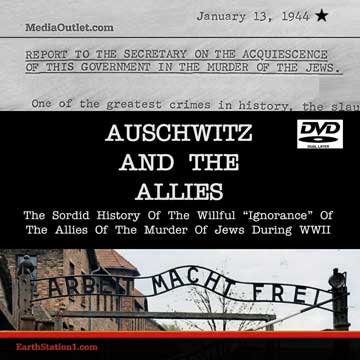
August 2: Roma Holocaust Memorial Day: --
Known with various slightly different names, The Roma Holocaust
Memorial Day commemorates the victims of The Romani Holocaust (The
Romani Genocide, The Porajmos (Romani: The Devouring), The
Pharrajimos (Romani: The Cutting Up, The Fragmentation, The
Destruction), The Samudaripen (Romani: Mass Killing), which
resulted in the murder of an estimated 220,000 - 500,000 Romani
people by Nazi Germany and its collaborators during World War II.
The date of August 2 was chosen for the memorial because on the
night of August 2-3 1944, 2,897 Roma, mostly women, children and
elderly people, were killed in the Gypsy family camp
(Zigeunerfamilienlager) at Auschwitz concentration camp. Some
countries have chosen to commemorate the genocide on different
dates. On Sale Until Midnight Tonight PT!
https://store.earthstation1.com/auschwitz-and-the-allies-dvd-complete-2-part-tv-serie2.html
Today's
EarthStation1.com 15% (Or More!) Off Commemorative Memorial Title:
Alexander The Great 1956 Richard Burton Frederic March DVD MP4 USB
Today, August 2, 2026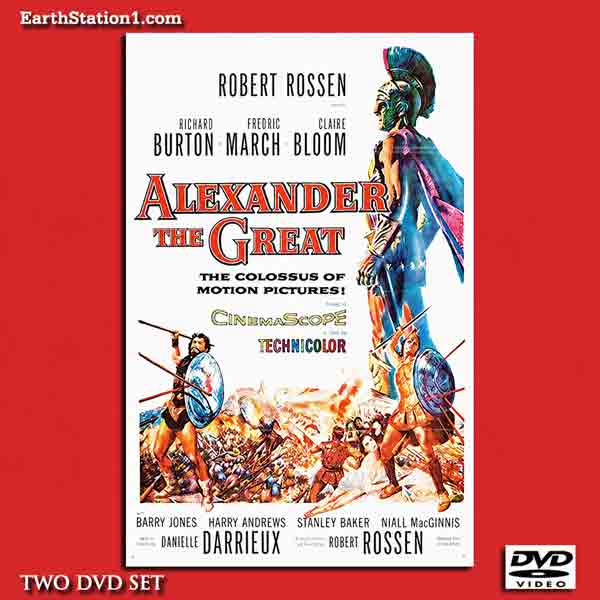
August 2, 338 BC: Macedonia: Ancient
Macedonia: Ancient Macedonian Wars: The Expansion Of Macedonia
Under Philip II: The Battle Of Chaeronea (338 BC): -- A Macedonian
army led by Philip II defeats the combined forces of Athens and
Thebes near the city of Chaeronea in Boeotia, and was the
culmination of Philip's final campaigns in 339-338 BC which
resulted in a decisive victory for the Macedonians and secured
Macedonian hegemony in Greece and the Aegean. Philip had brought
peace to a war-torn Greece in 346 BC, by ending the Third Sacred
War, and concluding his ten-year conflict with Athens for
supremacy in the north Aegean, by making a separate peace.
Philip's much expanded kingdom, powerful army and plentiful
resources now made him the de facto leader of Greece. To many of
the fiercely independent city-states, Philip's power after 346 BC
was perceived as a threat, especially in Athens, where the
politician Demosthenes led efforts to break away from Philip's
influence. In 340 BC Demosthenes convinced the Athenian assembly
to sanction action against Philip's territories and to ally with
the Achaemenids in Byzantium, which Philip was besieging. These
actions were against the terms of their treaty oaths and amounted
to a declaration of war. In summer 339 BC, Philip therefore led
his army towards South Greece, prompting the formation of an
alliance of a few southern Greek states opposed to him, led by
Athens and Thebes. After several months of stalemate, Philip
finally advanced into Boeotia in an attempt to march on Thebes and
Athens. Opposing him, and blocking the road near Chaeronea, was
the allied army, similar in size and occupying a strong position.
Details of the ensuing battle are scarce, but after a long fight
the Macedonians crushed both flanks of the allied line, which then
dissolved into a rout. The battle has been described as one of the
most decisive of the ancient world. The forces of Athens and
Thebes were destroyed, and continued resistance was impossible;
the war therefore came to an abrupt end. Philip was able to impose
a settlement upon southern Greece, which all states accepted, with
the exception of Sparta. The League of Corinth, formed as a
result, made all participants allies of Macedon and each other,
with Philip as the guarantor of the peace. In turn, Philip was
voted as strategos (general) for a pan-Hellenic war against the
Achaemenid Empire, also called the First Persian Empire, an
ancient Iranian empire based in Western Asia founded by Cyrus the
Great. which Philip had long planned. However, before he was able
to take charge of the campaign, Philip was assassinated, and the
Kingdom of Macedon and responsibility for the war with Persia
passed instead to his son Alexander. On Sale Until Midnight
Tonight PT!
https://store.earthstation1.com/alexander-the-great-1956-richard-burton-frederic-march-dvd-mp19564.html
Today's
EarthStation1.com 15% (Or More!) Off Commemorative Memorial Title:
Hannibal: The Terror Of Rome Documentary Series MP4 Video Download
DVD
Today, August 2, 2026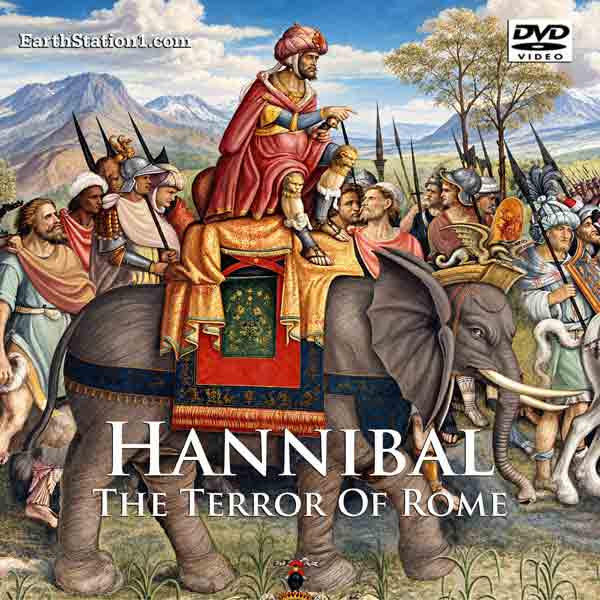
August 2, 216 BC: The Punic Wars: The
Second Punic War (The Hannibalic War): The Battle Of Cannae: --
Hannibal, "The Terror Of Rome", leads the armies of the
Carthaginians and their allies to a glorious victory over a
numerically superior Roman army, a victory regarded as one of the
greatest tactical feats in military history, a disasterous defeat
that ranks as one of the worst in Rome's history, and a battle
that in modern times is often cited as an example of the perfect
defeat of an enemy army. As news of this defeat reached Rome, the
city was gripped in panic. Authorities resorted to extraordinary
measures, which included consulting the Sibylline Books,
dispatching a delegation led by Quintus Fabius Pictor to consult
the Delphic oracle in Greece, and burying four people alive as a
sacrifice to their gods. To raise two new legions, the authorities
lowered the draft age and enlisted criminals, debtors and even
slaves. Despite the extreme loss of men and equipment, and a
second massive defeat later that same year at Silva Litana, the
Romans refused to surrender to Hannibal. His offer to ransom
survivors was brusquely refused. The Romans fought for 14 more
years until they achieved victory at the Battle of Zama. The
Battle of Cannae (pronouced "kan-EYE") was a key
engagement of the Second Punic War between the Roman Republic and
Carthage fought in a single day near the ancient village of Cannae
(Latin: "Cane") in Apulia, southeast Italy. The
Carthaginians and their allies, led by Hannibal, surrounded and
practically annihilated a larger Roman and Italian army under the
consuls Lucius Aemilius Paullus and Gaius Terentius Varro. Having
recovered from their losses at Trebia (218 BC) and Lake Trasimene
(217 BC), the Romans decided to engage Hannibal at Cannae, with
approximately 86,000 Roman and allied troops. They massed their
heavy infantry in a deeper formation than usual, while Hannibal
used the double envelopment tactic and surrounded his enemy,
trapping the majority of the Roman army, who were then
slaughtered. The loss of life on the Roman side meant it was one
of the most lethal single days of fighting in history; Adrian
Goldsworthy equates the death toll at Cannae to "the massed
slaughter of the British Army on the first day of the Somme
offensive in 1916". Only about 15,000 Romans, most of whom
were from the garrisons of the camps and had not taken part in the
battle, escaped death. Following the defeat, Capua and several
other Italian city-states defected from the Roman Republic to
Carthage. On Sale Until Midnight Tonight PT!
https://store.earthstation1.com/hannibal-the-terror-of-rome-documentary-series-mp4-video-download-dv4.html
Today's
EarthStation1.com 15% (Or More!) Off Commemorative Memorial Title:
The Great War (1964) TV Documentary Series DVD, Video Download,
USB
Today, August 2, 2026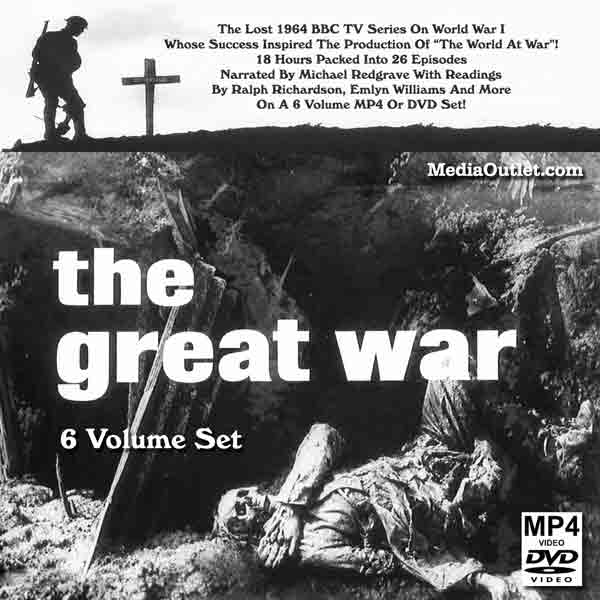
August 2, 1914: Causes Of The European
Civil War (Events Leading To The European Civil War): Causes Of
World War I (Events Leading To World War I): The Guns Of August:
The July Crisis: The German Occupation Of Luxembourg During World
War I: -- German forces invade and occupy Luxembourg. From August
2, 1914 until the end of World War I, The Grand Duchy Of
Luxembourg was under full occupation by the German Empire. The
German government justified the occupation by citing the need to
support their armies in neighbouring France, although many
Luxembourgers, past and present, have interpreted German actions
otherwise. During this period, Luxembourg was allowed to retain
its own government and political system, but all proceedings were
overshadowed by the German army's presence. Despite the
overbearing distraction of the occupation, the Luxembourgish
people attempted to lead their lives as normally as possible. The
political parties attempted to focus on other matters, such as the
economy, education, and constitutional reform. The domestic
political environment was further complicated by the death of Paul
Eyschen, who had been prime minister for 27 years. With his death
came a string of short-lived governments, culminating in
rebellion, and constitutional turmoil after the withdrawal of
German soldiers. The assassination of Austrian Archduke Ferdinand
on June 28, 1914 led to a month of diplomatic manoeuvring between
Austria-Hungary, Germany, Russia, France and Britain, called the
July Crisis. Austria-Hungary correctly believed that Serbian
officials (especially the officers of the Black Hand) were
involved in the plot to murder the Archduke, and wanted to finally
end Serbian interference in Bosnia. On July 23, Austria-Hungary
delivered to Serbia the July Ultimatum, a series of ten demands
that were made intentionally unacceptable, in an effort to provoke
a war with Serbia. Serbia decreed general mobilisation on the
25th. Serbia accepted all of the terms of the ultimatum except for
article six, which demanded that Austrian delegates be allowed in
Serbia for the purpose of participation in the investigation into
the assassination. Following this, Austria broke off diplomatic
relations with Serbia and, the next day, ordered a partial
mobilisation. Finally, on July 28, 1914, Austria-Hungary declared
war on Serbia. On 29 July, Russia, in support of Serbia, declared
partial mobilisation against Austria-Hungary. On the 30th, Russia
ordered general mobilisation. German Chancellor Bethmann-Hollweg
waited until the 31st for an appropriate response, when Germany
declared a "state of danger of war". Kaiser Wilhelm II
asked his cousin, Tsar Nicolas II, to suspend the Russian general
mobilisation. When he refused, Germany issued an ultimatum
demanding its mobilisation be stopped, and a commitment not to
support Serbia. Another was sent to France, asking her not to
support Russia if it were to come to the defence of Serbia. On
August 1, after the Russian response, Germany mobilised and
declared war on Russia. This also led to the general mobilisation
in Austria-Hungary on August 4. The German government issued
demands to France that it remain neutral as they had to decide
which deployment plan to implement, it being difficult if not
impossible to change the deployment whilst it was underway. The
modified German Schlieffen Plan, Aufmarsch II West, would deploy
80% of the army in the west, and Aufmarsch I Ost and Aufmarsch II
Ost would deploy 60% in the west and 40% in the east as this was
the maximum that the East Prussian railway infrastructure could
carry. The French did not respond, but sent a mixed message by
ordering their troops to withdraw 10 km (6 mi) from the border to
avoid any incidents, and at the same time ordered the mobilisation
of her reserves. Germany responded by mobilising its own reserves
and implementing Aufmarsch II West. On August 1, Wilhelm ordered
General Moltke to "march the whole of the _ army to the East"
after he had been wrongly informed that the British would remain
neutral as long as France was not attacked. The General convinced
the Kaiser that improvising the redeployment of a million men was
unthinkable and that making it possible for the French to attack
the Germans "in the rear" might prove disastrous. Yet
Wilhelm insisted that the German army should not march into
Luxembourg until he received a telegram sent by his cousin George
V, who made it clear that there had been a misunderstanding.
Eventually the Kaiser told Moltke, "Now you can do what you
want." Germany attacked Luxembourg on August 2, and on August
3 declared war on France. On August 4, after Belgium refused to
permit German troops to cross its borders into France, Germany
declared war on Belgium as well. Britain declared war on Germany
at 19:00 UTC on August 4, 1914 (effective from 11 pm), following
an "unsatisfactory reply" to the British ultimatum that
Belgium must be kept neutral. On Sale Until Midnight Tonight PT!
https://store.earthstation1.com/the-great-war-dvd-set-1964-wwi-tv-series-26-shows-1964266.html
Today's
EarthStation1.com 15% (Or More!) Off Commemorative Memorial Title:
The Guns Of August (1964) WWI Film DVD, Video Download, USB Drive
Today, August 2, 2026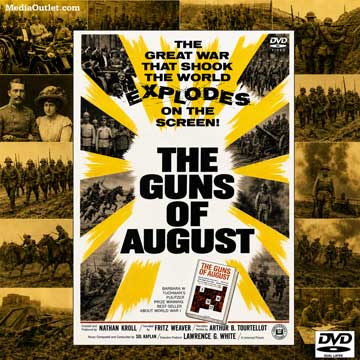
August 2, 1914: Causes Of The European
Civil War (Events Leading To The European Civil War): Causes Of
World War I (Events Leading To World War I): The Guns Of August:
The July Crisis: The German Invasion Of Belgium (1914): -- The
German government sends an ultimatum to Belgium, demanding passage
through the country. On July 24, the Belgian government had
announced that if war came it would uphold its neutrality, and on
July 31 the Belgian government mobilised its armed forces. Germany
responded by proclaiming a state of heightened alert
(Kriegsgefahr) in response. On August 4, the Belgian government
refused the German demands, while simultaneously the British
government guaranteed military support to Belgium. The German
government responded that same day by declaring war on Belgium,
and German troops crossed the border and began The Battle Of Liege
late the next day. The assassination of Austrian Archduke
Ferdinand on June 28, 1914 led to a month of diplomatic
manoeuvring between Austria-Hungary, Germany, Russia, France and
Britain, called the July Crisis. Austria-Hungary correctly
believed that Serbian officials (especially the officers of the
Black Hand) were involved in the plot to murder the Archduke, and
wanted to finally end Serbian interference in Bosnia. On July 23,
Austria-Hungary delivered to Serbia the July Ultimatum, a series
of ten demands that were made intentionally unacceptable, in an
effort to provoke a war with Serbia. Serbia decreed general
mobilisation on the 25th. Serbia accepted all of the terms of the
ultimatum except for article six, which demanded that Austrian
delegates be allowed in Serbia for the purpose of participation in
the investigation into the assassination. Following this, Austria
broke off diplomatic relations with Serbia and, the next day,
ordered a partial mobilisation. Finally, on July 28, 1914,
Austria-Hungary declared war on Serbia. On 29 July, Russia, in
support of Serbia, declared partial mobilisation against
Austria-Hungary. On the 30th, Russia ordered general mobilisation.
German Chancellor Bethmann-Hollweg waited until the 31st for an
appropriate response, when Germany declared a "state of
danger of war". Kaiser Wilhelm II asked his cousin, Tsar
Nicolas II, to suspend the Russian general mobilisation. When he
refused, Germany issued an ultimatum demanding its mobilisation be
stopped, and a commitment not to support Serbia. Another was sent
to France, asking her not to support Russia if it were to come to
the defence of Serbia. On August 1, after the Russian response,
Germany mobilised and declared war on Russia. This also led to the
general mobilisation in Austria-Hungary on August 4. The German
government issued demands to France that it remain neutral as they
had to decide which deployment plan to implement, it being
difficult if not impossible to change the deployment whilst it was
underway. The modified German Schlieffen Plan, Aufmarsch II West,
would deploy 80% of the army in the west, and Aufmarsch I Ost and
Aufmarsch II Ost would deploy 60% in the west and 40% in the east
as this was the maximum that the East Prussian railway
infrastructure could carry. The French did not respond, but sent a
mixed message by ordering their troops to withdraw 10 km (6 mi)
from the border to avoid any incidents, and at the same time
ordered the mobilisation of her reserves. Germany responded by
mobilising its own reserves and implementing Aufmarsch II West. On
August 1, Wilhelm ordered General Moltke to "march the whole
of the _ army to the East" after he had been wrongly informed
that the British would remain neutral as long as France was not
attacked. The General convinced the Kaiser that improvising the
redeployment of a million men was unthinkable and that making it
possible for the French to attack the Germans "in the rear"
might prove disastrous. Yet Wilhelm insisted that the German army
should not march into Luxembourg until he received a telegram sent
by his cousin George V, who made it clear that there had been a
misunderstanding. Eventually the Kaiser told Moltke, "Now you
can do what you want." Germany attacked Luxembourg on August
2, and on August 3 declared war on France. On August 4, after
Belgium refused to permit German troops to cross its borders into
France, Germany declared war on Belgium as well. Britain declared
war on Germany at 19:00 UTC on August 4, 1914 (effective from 11
pm), following an "unsatisfactory reply" to the British
ultimatum that Belgium must be kept neutral. On Sale Until
Midnight Tonight PT!
https://store.earthstation1.com/the-guns-of-august-dvd-1964-world-war-i-movie-documen1964.html
Today's
EarthStation1.com 15% Off Commemorative Memorial Title: Hearts And
Minds 1974 Vietnam War Documentary Film MP4 Download Or DVD
Today, August 2, 2026
August 2, 1964: The Aftermath Of World
War II: The Cold War: The Cold War In Asia: The Indochina Wars:
The Vietnam War (The Second Indochina War, The Vietnam Conflict,
The Resistance War Against America): The United States In The
Vietnam War: The Gulf of Tonkin Incidents (Vietnamese: Su Kien
Vinh Bac Bo): The First Gulf Of Tonkin Incident (The USS Maddox
Incident): -- North Vietnamese torpedo boats fire on the U.S.
destroyer USS Maddox in The Gulf Of Tonkin, an international
confrontation that led to the United States engaging more directly
in the Vietnam War, an attack in response to both Maddox's then
unadmitted firing of warning shots towards the torpedo boats, and
her sailing with the 12 mile territorial limit long recognized
along the coast of Indochina, a limit the United States refused to
recognize. In July 1964, the situation along North Vietnam's
territorial waters had reached a near boil because of South
Vietnamese commando raids and airborne operations that inserted
intelligence teams into North Vietnam, as well as North Vietnam's
military response to these operations. On the night of July 30,
1964, South Vietnamese commandos attacked a North Vietnamese radar
station on Hon Me island. According to Hanyok, "it would be
attacks on these islands, especially Hon Me, by South Vietnamese
commandos, along with the proximity of the Maddox, that would set
off the confrontation", although the Maddox did not
participate in the commando attacks. In this context, on July 31,
Maddox began patrols of the North Vietnamese coast to collect
intelligence, coming within a few miles of Hon Me island. A U.S.
aircraft carrier, the USS Ticonderoga, was also stationed nearby.
By August 1, North Vietnamese patrol boats were tracking Maddox,
and when she was confronted, whe was approaching Hon Me Island,
three to four nautical miles (nmi) (6 to 7 km) inside the 12
nautical miles (22 km; 14 mi) limit claimed by North Vietnam. This
territorial limit was unrecognized by the United States, despite
the fact that this distance is the internationally accepted limit.
Several intercepted communications indicated that the patrol boats
were preparing to attack. Maddox retreated, but the next day,
August 2, Maddox, which had a top speed of 28 knots, resumed her
routine patrol, and three North Vietnamese P-4 torpedo boats with
a top speed of 50 knots began to follow Maddox. The boats were
from Squadron 135, commanded by Le Duy Khoai, with the boats
commanded by brothers Van Bot, Van Tu, and Van Gian. Intercepted
communications indicated that the vessels intended to attack
Maddox. As the ships approached from the southwest, Maddox changed
course from northeasterly to southeasterly and increased speed to
25 knots. As the torpedo boats neared, Maddox fired three warning
shots; a 2001 internal NSA historical study which states "This
initial action was never reported by the Johnson administration,
which insisted that the Vietnamese boats fired first." The
North Vietnamese boats then attacked, and Maddox radioed she was
under attack from the three boats, closing to within 10 nautical
miles (19 km; 12 mi), while located 28 nautical miles (52 km; 32
mi) away from the North Vietnamese coast in international waters.
Maddox stated she had evaded a torpedo attack and opened fire with
its five-inch (127 mm) guns, forcing the torpedo boats away. Two
of the torpedo boats had come as close as 5 nautical miles (9.3
km; 5.8 mi) and released one torpedo each, but neither one was
effective, coming no closer than about 100 yards (91 m) after
Maddox evaded them. Another P-4 received a direct hit from a
five-inch shell from Maddox; its torpedo malfunctioned at launch.
Four USN F-8 Crusader jets were launched from Ticonderoga, and 15
minutes after Maddox had fired her initial warning shots, the
Crusaders attacked the retiring P-4s, claiming one was sunk and
one heavily damaged. Maddox suffered only minor damage from a
single 14.5 mm bullet from a P-4's KPV heavy machine gun into her
superstructure. Retiring to South Vietnamese waters, Maddox was
joined by the destroyer USS Turner Joy. After the skirmish,
Johnson ordered Maddox and Turner Joy to stage daylight runs into
North Vietnamese waters, testing the 12 nautical miles (22 km; 14
mi) limit and North Vietnamese resolve. These runs into North
Vietnamese territorial waters coincided with South Vietnamese
coastal raids and were interpreted as coordinated operations by
the North, which officially acknowledged the engagements of August
2, 1964. Admiral U. S. Grant Sharp Jr., Commander-in-Chief, United
States Pacific Command (CINCPAC) during The Gulf Of Tonkin
Incident, maintained that U.S. actions did not provoke the August
2 incident. He claimed that the North Vietnamese had tracked
Maddox along the coast by radar and were thus aware that the
destroyer had not actually attacked North Vietnam and that Hanoi
(or the local commander) had ordered its craft to engage Maddox
anyway. North Vietnamese general Phung The Tai later claimed that
Maddox had been tracked since July 31 and that she had attacked
fishing boats on August 2 forcing the North Vietnamese Navy to
"fight back". Sharp also noted that orders given to
Maddox to stay 8 nautical miles (15 km; 9.2 mi) off the North
Vietnamese coast put the ship in international waters, as North
Vietnam claimed only a 5 nautical miles (9.3 km; 5.8 mi) limit as
its territory (or off of its off-shore islands). In addition, many
nations had previously carried out similar missions all over the
world, and the destroyer USS John R. Craig had earlier conducted
an intelligence-gathering mission in similar circumstances without
incident. Sharp's claims, however, included some factually
incorrect statements. North Vietnam did not adhere to an
8-kilometer (5 mi) limit for its territorial waters; instead it
adhered to a 20-kilometer (12 mi) limit claimed by French
Indochina in 1936. Moreover it officially claimed a 12 nmi limit,
which is practically identical to the old 20 km French claim,
after the incidents of August, in September 1964. The North
Vietnamese stance is that they always considered a 12 nautical
mile limit, consistent with the positions regarding the law of the
sea of both the Soviet Union and China, their main allies. The
Gulf Of Tonkin Incidents involved either one or two separate
confrontations involving North Vietnam and the United States in
the waters of the Gulf Of Tonkin. The original American report
blamed North Vietnam for both incidents, but eventually became
very controversial with widespread belief that at least one, and
possibly both incidents were false, and possibly deliberately so.
On August 2, 1964, the destroyer USS Maddox, while performing a
signals intelligence patrol as part of DESOTO operations, was
pursued by three North Vietnamese Navy torpedo boats of the 135th
Torpedo Squadron. Maddox fired three warning shots and the North
Vietnamese boats then attacked with torpedoes and machine gun
fire. Maddox expended over 280 3-inch (75 mm) and 5-inch (130 mm)
shells in a sea battle. One U.S. aircraft was damaged, three North
Vietnamese torpedo boats were damaged, and four North Vietnamese
sailors were killed, with six more wounded. There were no U.S.
casualties. Maddox "was unscathed except for a single bullet
hole from a Vietnamese machine gun round." It was originally
claimed by the National Security Agency that a Second Gulf Of
Tonkin Incident occurred on August 4, 1964, as another sea battle,
but instead evidence was found of "Tonkin ghosts" (false
radar images) and not actual North Vietnamese torpedo boats. In
the 2003 documentary The Fog of War, the former United States
Secretary Of Defense Robert S. McNamara admitted that the August 2
USS Maddox attack happened with no Defense Department response,
but the August 4 Gulf Of Tonkin attack never happened. In 1995,
McNamara met with former Vietnam People's Army General Vo Nguyen
Giap to ask what happened on August 4, 1964 in the second Gulf Of
Tonkin Incident. "Absolutely nothing", Giap replied.
Giap claimed that the attack had been imaginary. The outcome of
these two incidents was the passage by Congress of the Gulf Of
Tonkin Resolution, which granted President Lyndon B. Johnson the
authority to assist any Southeast Asian country whose government
was considered to be jeopardized by "communist aggression".
The resolution served as Johnson's legal justification for
deploying U.S. conventional forces and the commencement of open
warfare against North Vietnam. In 2005, an internal National
Security Agency historical study was declassified; it concluded
that Maddox had engaged the North Vietnamese Navy on August 2, but
that there were no North Vietnamese naval vessels present during
the incident of August 4. The report stated, regarding the first
incident on August 2: "at 1500G, Captain Herrick ordered
Ogier's gun crews to open fire if the boats approached within ten
thousand yards (9,150 m). At about 1505G, Maddox fired three
rounds to warn off the communist boats. This initial action was
never reported by the Johnson administration, which insisted that
the Vietnamese boats fired first." On Sale @ 15% Off Discount
Till Midnight PT! On Sale Until Midnight Tonight PT!
https://store.earthstation1.com/hearts-and-minds-dvd-1974-vietnam-war-documentary-m1974.html
Today's
EarthStation1.com 15% (Or More!) Off Commemorative Memorial Title:
Saddam Hussein: His Life, His Regime, His Iraq DVD, Download, USB
Today, August 2, 2026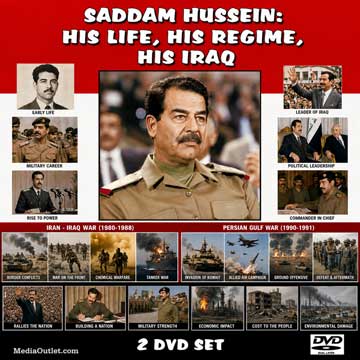
August 2, 1990: The Aftermath Of World
War II: The Cold War: The Gulf War (The Persian Gulf War, Gulf War
I): The Invasion Of Kuwait: -- Shortly after midnight local time,
about 100,000 Iraqi troops invade Kuwait under orders from Saddam
Hussein amid Hussein's claims that Kuwait threatened Iraq's
economic existence by overproducing oil and driving prices down on
the world market. In the two days after the invasion began, most
Kuwaiti troops were overrun by the Iraqis and most Kuwaiti
officials had retreated to Saudi Arabia and Bahrain, defeating the
State of Kuwait on August 4, 1990. Iraq went on to militarily
occupy the country for the next seven months. The invasion was
condemned internationally, and the United Nations Security Council
(UNSC) adopted numerous resolutions urging Iraq to withdraw from
Kuwaiti territory. The Iraqi military, however, continued to
occupy Kuwait and defied all orders by the UNSC. After initially
establishing the "Republic of Kuwait" as a puppet state,
Iraq annexed the entire country on 28 August 1990; northern Kuwait
became the Saddamiyat al-Mitla' District and was merged into the
existing Basra Governorate, while southern Kuwait was carved out
as the all-new Kuwait Governorate. By November 1990, the adoption
of UNSC Resolution 678 officially issued Iraq an ultimatum to
withdraw unconditionally by 15 January 1991 or else be removed by
"all necessary means" from Kuwaiti territory. In
anticipation of a war with Iraq, the UNSC authorized the assembly
of an American-led military coalition. After Iraq failed to meet
the UNSC's deadline, the coalition pursued the directive to
forcefully expel Iraqi troops from Kuwait by initiating the Gulf
War aerial bombardment campaign on 17 January 1991. As the
bombardment campaign continued over the next month, Iraq fired
missiles at Israel; the Iraqi government had hoped that an Israeli
retaliation would prompt the coalition's Muslim-majority states to
rescind their support for the campaign against Iraq. However, no
such retaliation took place, and the coalition began a ground
invasion of Iraqi-occupied Kuwait and parts of Iraq on 23 February
1991. As Iraqi troops retreated from Kuwait, they set fire to over
700 Kuwaiti oil wells, but this strategy was ultimately
unsuccessful in thwarting the coalition's advance. By 28 February
1991, the Iraqi military had been devastated and Kuwaiti
independence was restored. Though the true intent behind Iraq's
decision to attack Kuwait is disputed, a variety of speculations
have been made. One possible motive concerned Iraq's inability to
repay the 14B USD that it had borrowed from Kuwait during the
Iran-Iraq War. Proponents of this theory point to Kuwait's surge
in petroleum production, which kept Iraq's revenues down; Kuwait's
oil production levels were above the mandatory quota that was
specified by the Organization of the Petroleum Exporting Countries
(OPEC), which had consequently urged the country to moderate
production amidst a sharp decrease in global oil prices. Iraq
interpreted the Kuwaiti government's refusal to decrease oil
production as an act of aggression against the Iraqi economy. In
early 1990, Iraq accused Kuwait of slant drilling to steal Iraqi
petroleum across the Iraq-Kuwait border, though some Iraqi sources
indicated that Saddam Hussein had already made the decision to
attack Kuwait a few months before the actual invasion. On Sale
Until Midnight Tonight PT!
https://store.earthstation1.com/saddam-hussein-his-life--his-regime--his-iraq-dvd-3-disc3.html
Today's
EarthStation1.com 15% (Or More!) Off Commemorative Memorial Title:
Desert Triumph: The Gulf War TV Documentary Series DVD & MP4
Download
Today, August 2, 2026
August 2, 1990: The Aftermath Of World
War II: The Cold War: The Gulf War (The Persian Gulf War, Gulf War
I): The Invasion Of Kuwait: The Battle Of Dasman Palace: --
Between 04:00 and 06:00, Iraqi special forces, variously reported
as helicopter airborne troops, or as infiltrators in civilian
clothes, attack on Dasman Palace, the residence of Jaber Al-Ahmad
Al-Sabah, the Emir of Kuwait. The Iraqi forces were reinforced
through the battle by the arrival of further troops, notably
elements of the Republican Guard "Hammurabi" Division
that had passed to the east of Al Jahra, using Highway 80 to
attack into Kuwait City. Fighting was fierce, especially around
midday, but ended around 14:00 with the Iraqis taking control of
the palace. They were thwarted in their aim of capturing the Emir
and his advisors, who had relocated to General Headquarters before
the assault began and fled to Saudi Arabia with his family and
ministers. Among the casualties was the Emir's younger brother,
Fahd Al-Ahmad, who was killed as he arrived to defend the palace.
An Iraqi military government was then installed in Kuwait which
was annexed by Iraq on the claim that Kuwait was historically part
of Iraq. This resulted in Desert Shield, the massive Allied
military buildup, and later the 100-hour war against Iraq, Desert
Storm. On Sale Until Midnight Tonight PT!
https://store.earthstation1.com/desert-triumph-the-gulf-war-tv-documentary-series-dvd-amp-mp4-downloa4.html
Today's
EarthStation1.com 15% (Or More!) Off Commemorative Memorial Title:
The Gulf Crisis: The Road To War TV Series + Bonus 2 DVDs MP4
Download
Today, August 2, 2026
August 2, 1990: The Aftermath Of World
War II: The Cold War: The Gulf War (The Persian Gulf War, Gulf War
I): The Invasion Of Kuwait: United Nations Security Council
Resolution 660: -- The United Nations Security Council (UNSC),
after noting its alarm of the Invasion Of Kuwait by Iraq, condemns
the Iraqi Invasion Of Kuwait and demands that Iraq withdraw
immediately and unconditionally to positions as they were on
August 1, 1990. Yemen called upon Iraq and Kuwait to enter into
immediate negotiations to resolve their differences, thanking the
Arab League for its efforts. The Council also decided to meet
again as necessary to ensure compliance with the current
resolution. The resolution was adopted by 14 votes to none, while
Yemen is the only Arab country that did not participate in voting.
It was the first of twelve resolutions on the conflict passed in
1990. On Sale Until Midnight Tonight PT!
https://store.earthstation1.com/the-gulf-crisis-the-road-to-war-tv-documentary-series-dvd-mp4-us4.html
Today's
EarthStation1.com 15% (Or More!) Off Commemorative Memorial Title:
The Weapons Of Desert Shield + Bonus Persian Gulf War DVD MP4
Download
Today, August 2, 2026
August 2, 1990: The Aftermath Of World
War II: The Cold War: The Gulf War (The Persian Gulf War, Gulf War
I): The Invasion Of Kuwait: Operation Desert Shield: -- The United
States initiates a buildup of military forces to provide for Saudi
Arabia's defense, marking the beginning of Operation Desert
Shield, which lasted from August 2 1990 to January 16 1991, when
it was superceded by Operation Desert Storm (January 17, 1991 -
February 28, 1991), a war waged by coalition forces from 35
nations led by the United States against Iraq in order to drive
them away from the Saudi Arabian border and ultimately to eject
them from Kuwait. One of the West's main concerns was the
significant threat Iraq posed to Saudi Arabia. Following Kuwait's
conquest, the Iraqi Army was within easy striking distance of
Saudi oil fields. Control of these fields, along with Kuwaiti and
Iraqi reserves, would have given Saddam control over the majority
of the world's oil reserves. Iraq also had a number of grievances
with Saudi Arabia. The Saudis had lent Iraq some 26 billion
dollars during its war with Iran. The Saudis had backed Iraq in
that war, as they feared the influence of Shia Iran's Islamic
revolution on its own Shia minority. After the war, Saddam felt he
should not have to repay the loans due to the help he had given
the Saudis by fighting Iran. Soon after his conquest of Kuwait,
Saddam began verbally attacking the Saudis. He argued that the
US-supported Saudi state was an illegitimate and unworthy guardian
of the holy cities of Mecca and Medina. He combined the language
of the Islamist groups that had recently fought in Afghanistan
with the rhetoric Iran had long used to attack the Saudis. Acting
on the Carter Doctrine policy, and out of fear the Iraqi Army
could launch an invasion of Saudi Arabia, US President George H.
W. Bush quickly announced that the US would launch a "wholly
defensive" mission to prevent Iraq from invading Saudi
Arabia, under the codename Operation Desert Shield. The operation
began on 7 August 1990, when US troops were sent to Saudi Arabia,
due also to the request of its monarch, King Fahd, who had earlier
called for US military assistance. This "wholly defensive"
doctrine was quickly abandoned when, on 8 August, Iraq declared
Kuwait to be Iraq's 19th province and Saddam named his cousin, Ali
Hassan Al-Majid, as its military-governor. The US Navy dispatched
two naval battle groups built around the aircraft carriers USS
Dwight D. Eisenhower and USS Independence to the Persian Gulf,
where they were ready by 8 August. The US also sent the
battleships USS Missouri and USS Wisconsin to the region. A total
of 48 US Air Force F-15s from the 1st Fighter Wing at Langley Air
Force Base, Virginia, landed in Saudi Arabia and immediately
commenced round-the-clock air patrols of the Saudi-Kuwait-Iraq
border to discourage further Iraqi military advances. They were
joined by 36 F-15 A-Ds from the 36th Tactical Fighter Wing at
Bitburg, Germany. The Bitburg contingent was based at Al Kharj Air
Base, approximately an hour south east of Riyadh. The 36th TFW
would be responsible for 11 confirmed Iraqi Air Force aircraft
shot down during the war. Two Air National Guard units were
stationed at Al Kharj Air Base, the South Carolina Air National
Guard's 169th Fighter Wing flew bombing missions with 24 F-16s
flying 2,000 combat missions and dropping four million pounds
(1,800,000 kilograms; 1,800 metric tons) of munitions, and the New
York Air National Guard's 174th Fighter Wing from Syracuse flew 24
F-16s on bombing missions. Military buildup continued from there,
eventually reaching 543,000 troops, twice the number used in the
2003 invasion of Iraq. Much of the material was airlifted or
carried to the staging areas via fast sealift ships, allowing a
quick buildup. As part of the buildup, amphibious exercises were
carried out in the Gulf, including Operation Imminent Thunder,
which involved the USS Midway and 15 other ships, 1,100 aircraft,
and a thousand Marines. In a press conference, General Schwarzkopf
stated that these exercises were intended to decieve the Iraqi
forces, forcing them to continue their defense of the Kuwaiti
coastline. On Sale Until Midnight Tonight PT!
https://store.earthstation1.com/the-weapons-of-desert-shield-persian-gulf-war-i-dvd-mp4-download-us4.html
Today's
EarthStation1.com 15% (Or More!) Off Commemorative Memorial Title:
Secret Files: History Of Washington, Israel & The Gulf DVD,
MP4, USB
Today, August 2, 2026
August 2, 1990: The Aftermath Of World
War II: The Cold War: The Gulf War (The Persian Gulf War, Gulf War
I): The Invasion Of Kuwait: -- Egypt and Saudi Arabia attempt to
mediate between the two countries with a meeting on meeting
between Iraq and Kuwait in Jeddah, Saudi Arabia. Iraq clearly
stated on this occasion that it would not use armed forces against
neighboring countries. However, at dawn on August 2, the Iraqi
army that was amassed near the border suddenly invaded Kuwait. On
July 24, 1990, President of Egypt Hosni Mubarak traveled to
Baghdad to meet with Saddam Hussein and discuss the dispute
between Kuwait and Iraq, to no avail. On July 22, 1990, Iraq began
deploying troops to the Iraqi-Kuwaiti border, creating a massive
military buildup in preparation for what would become the Iraqi
Invasion Of Kuwait, which ultimately resultd in the Gulf War (Gulf
War I). Iraq accused Kuwait onn July 15, 1990 of stealing oil from
the Rumaila oil field, an Iraqi oil field near the Iraqi-Kuwaiti
border, and threatened military action in response. In 1988 Iraq's
Oil Minister, Issam al-Chalabi, stressed a further reduction in
the crude oil production quota of Organization of the Petroleum
Exporting Countries (OPEC) members so as to end the 1980s oil
glut. Chalabi argued that higher oil prices would help Iraq
increase its revenues and pay back its 60B USD debt. However,
given its large downstream petroleum industry, Kuwait was less
concerned about the prices of crude oil and in 1989, Kuwait
requested OPEC to increase the country's total oil production
ceiling by 50% to 1.35 million bpd. Throughout much of the 1980s,
Kuwait's oil production was considerably above its mandatory OPEC
quota and this had prevented a further increase in crude oil
prices. A lack of consensus among OPEC members undermined Iraq's
efforts to end the oil glut and consequently prevented the
recovery of its war-crippled economy. According to former Iraqi
Foreign Minister Tariq Aziz, "every 1 USD drop in the price
of a barrel of oil caused a 1B USD drop in Iraq's annual revenues
triggering an acute financial crisis in Baghdad". Kuwait's
refusal to decrease its oil production was viewed by Iraq as an
act of aggression against it. The increasingly tense relations
between Iraq and Kuwait were further aggravated when Iraq alleged
that Kuwait was slant-drilling across the border into Iraq's
Rumaila field. The dispute over Rumaila field started in 1960 when
an Arab League declaration marked the Iraq-Kuwait border 2 miles
north of the southernmost tip of the Rumaila field. During the
Iran-Iraq War, Iraqi oil drilling operations in Rumaila declined
while Kuwait's operations increased. In 1989, Iraq accused Kuwait
of using "advanced drilling techniques" to exploit oil
from its share of the Rumaila field. Iraq estimated that 2.4B USD
worth of Iraqi oil was "stolen" by Kuwait and demanded
compensation. Kuwait dismissed the accusations as a false Iraqi
ploy to justify military action against it. Several foreign firms
working in the Rumaila field also dismissed Iraq's slant-drilling
claims as a "smokescreen to disguise Iraq's more ambitious
intentions". On July 25, 1990, only a few days before the
Iraqi invasion, OPEC officials said that Kuwait and the United
Arab Emirates had agreed to a proposal to limit daily oil output
to 1.5 million barrels, thus potentially settling differences over
oil policy between Kuwait and Iraq. At the time of the settlement,
more than 100,000 Iraqi troops were deployed along the Iraq-Kuwait
border, and American officials expressed little indication of
decline in tensions despite the OPEC settlement. On Sale Until
Midnight Tonight PT!
https://store.earthstation1.com/secret-files-history-of-washington-israel-amp-the-gulf-dvd-download-usb.html
Today's
EarthStation1.com 15% (Or More!) Off Commemorative Memorial Title:
Summer Of The Bomb: Why US Really Nuked Japan DVD, Download, USB
Drive
Today, August 2, 2026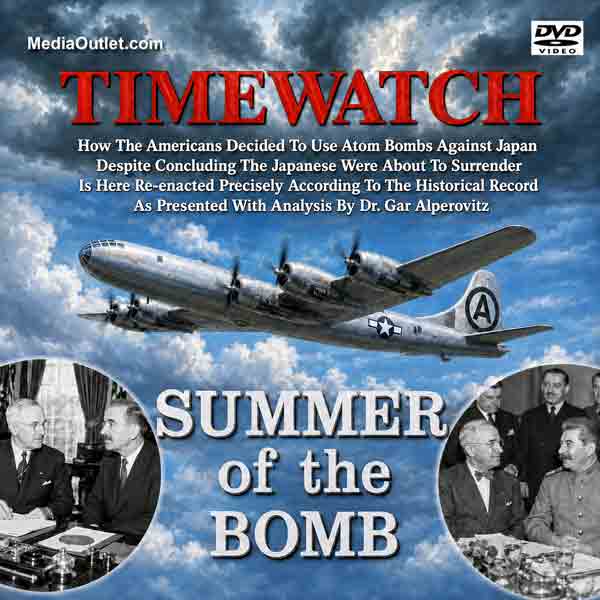
August 2, 1945: The European Civil War:
World War II: The Second European War (The European Theater Of
World War II): World War II Conferences: The Potsdam Conference
(July 17 - August 2, 1945) (German: Potsdamer Konferenz; Soviet
Union: The Berlin Conference Of The Three Heads Of Government Of
The USSR, USA and UK): -- The main three leaders of the Allied
nations, Winston Churchill, Harry S. Truman and Joseph Stalin,
conclude The Potsdam Conference in the German city of Potsdam to
decide the future of a defeated Germany and to plan and organize
the defeat of Imperial Japan. The Potsdam Conference (German:
Potsdamer Konferenz) was held at Cecilienhof, the home of Crown
Prince Wilhelm, in Potsdam, occupied Germany, from July 17 to
August 2, 1945. (In some older documents it is also referred to as
the Berlin Conference of the Three Heads of Government of the
USSR, USA and UK.) The participants were the Soviet Union, the
United Kingdom, and the United States, represented by Communist
Party General Secretary Joseph Stalin, Prime Ministers Winston
Churchill and, later, Clement Attlee, and President Harry S.
Truman. Stalin, Churchill, and Truman-as well as Attlee, who
participated alongside Churchill while awaiting the outcome of the
1945 general election, and then replaced Churchill as Prime
Minister after the Labour Party's defeat of the
Conservatives-gathered to decide how to administer the defeated
Nazi Germany, which had agreed to unconditional surrender nine
weeks earlier, on 8 May (V-E Day). The goals of the conference
also included the establishment of postwar order, peace treaty
issues, and countering the effects of the war. At the Yalta
Conference France had been granted an occupation zone within
Germany, France had been a participant in the Berlin Declaration,
and France was to be an equal member of the Allied Control
Council. Nevertheless, at the insistence of the Americans, General
de Gaulle was not invited to Potsdam; a diplomatic slight which
was a cause of deep and lasting resentment. Reasons for the
omission included the longstanding personal mutual antagonism
between Roosevelt and De Gaulle, ongoing disputes over the French
and American occupation zones and anticipated conflicts of
interest over French Indochina; but also reflected the judgement
of both the British and Americans that French aims in respect of
many items on the Conference agenda were likely to be at variance
with Anglo/American agreed objectives. On July 26, 1945, the
Potsdam Declaration was issued, whereby Winston Churchill, Harry
Truman and China's representatives issued a demand for
unconditional Japanese surrender. The Potsdam Declaration, or the
Proclamation Defining Terms for Japanese Surrender, is issued by
United States President Harry S. Truman, United Kingdom Prime
Minister Winston Churchill, and Chairman of the Nationalist
Government of China Chiang Kai-shek, a statement that called for
the surrender of all Japanese armed forces during World War II,
and outlined the terms of surrender for the Empire Of Japan as
agreed upon at the Potsdam Conference. This ultimatum stated that,
if Japan did not surrender, it would face "prompt and utter
destruction". The Japanese, not realizing that these demands
were backed up by the newly invented American atomic bomb, issued
an ambiguous rejection. The Potsdam Declaration declared of its
terms for Japan's surrender that "We will not deviate from
them. There are no alternatives. We shall brook no delay."
For Japan, the terms of the declaration specified: 1) the
elimination "for all time of the authority and influence of
those who have deceived and misled the people of Japan into
embarking on world conquest"; 2) the occupation of "points
in Japanese territory to be designated by the Allies"; 3)
that the "Japanese sovereignty shall be limited to the
islands of Honshu, Hokkaido, Kyushu, Shikoku, and such minor
islands as we determine", as had been announced in the Cairo
Declaration in 1943; 4) that "the Japanese military forces,
after being completely disarmed, shall be permitted to return to
their homes with the opportunity to lead peaceful and productive
lives"; and 5) that "we do not intend that the Japanese
shall be enslaved as a race or destroyed as a nation, but stern
justice shall be meted out to all war criminals, including those
who have visited cruelties upon our prisoners". On the other
hand, the declaration offered that: 1) "The Japanese
Government shall remove all obstacles to the revival and
strengthening of democratic tendencies among the Japanese people.
Freedom of speech, of religion, and of thought, as well as respect
for the fundamental human rights shall be established."; 2)
"Japan shall be permitted to maintain such industries as will
sustain her economy and permit the exaction of just reparations in
kind, but not those which would enable her to rearm for war. To
this end, access to, as distinguished from control of, raw
materials shall be permitted. Eventual Japanese participation in
world trade relations shall be permitted."; and 3) "The
occupying forces of the Allies shall be withdrawn from Japan as
soon as these objectives have been accomplished and there has been
established, in accordance with the freely expressed will of the
Japanese people, a peacefully inclined and responsible
government.". The mention of "unconditional surrender"
came at the end of the declaration: "We call upon the
government of Japan to proclaim now the unconditional surrender of
all Japanese armed forces, and to provide proper and adequate
assurances of their good faith in such action. The alternative for
Japan is prompt and utter destruction." The Declaration was
released to the press in Potsdam on the evening of July 26 and
simultaneously transmitted to the Office of War Information (OWI)
in Washington. By 5 p.m. Washington time, OWI's West Coast
transmitters, aimed at the Japanese home islands, were
broadcasting the text in English, and two hours later began
broadcasting it in Japanese. Simultaneously, American bombers
dropped over 3 million leaflets describing the declaration over
Japan. The Declaration was never transmitted to the Japanese
government through diplomatic channels. Although picking up enemy
propaganda leaflets and listening to foreign radio broadcasts (in
Japan) was illegal, the American propaganda efforts were
successful in making the key points of the declaration known to
most Japanese. The terms of the declaration were hotly debated
within the Japanese government. Upon receiving the declaration,
Foreign Minister Shigenori Togo hurriedly met with Prime Minister
Kantaro Suzuki and Cabinet Secretary Hisatsune Sakomizu. Sakomizu
recalled that all felt the declaration must be accepted. Despite
being sympathetic to accepting the terms, Togo felt it was vague
concerning the eventual form of government for Japan, disarmament,
and the fate of accused war criminals, and still had hope that the
Soviet Union would agree to mediate negotiations with the Western
Allies to obtain clarifications and revisions of the declaration's
terms. Shortly afterwards, Togo met with Emperor Hirohito, and
advised him to treat the declaration with the utmost
circumspection, but that a reply should be postponed until the
Soviet response to the Japanese request to mediate peace. Hirohito
stated that the declaration was "acceptable in principle".
Meanwhile, the Supreme Council for the Direction of the War met
the same day to discuss the declaration. War Minister Korechika
Anami, General Yoshijiro Umezu, and Admiral Teijiro Toyoda opposed
accepting the declaration, arguing that the terms were "too
dishonorable", and advised that the Japanese government
openly reject it. Suzuki, Togo, and Admiral Mitsumasa Yonai leaned
towards accepting it, but agreed that clarification was needed
over the status of the Emperor. Togo's suggestion that the
government not respond until it received the Soviet response was
accepted. At a press conference with the Japanese press in Tokyo,
Suzuki stated that the Japanese policy towards the declaration
would be one of "mokusatsu", which the United States
interpreted to mean "to kill with silence", in other
words "to ignore", leading to a swift decision by the
Allies to carry out the threat of destruction. However, the word
can also mean "no comment", as it was apparently
intended in this case to mean. President Truman and his advisers
had mulled over the meaning of mokusatsu before making a decision.
One meaning was a matter of politeness among the upper classes. An
unacceptable offer is made, and the other person, not wanting to
offend the speaker, pretends not to have heard. The other person
realizes his mistake, and makes a better offer. The other meaning
is to view with silent contempt. The White House decided that the
second meaning was intended. After the war, Prime Minister Suzuki
stated that his words were not meant for international
consumption, nor to be taken as an official message. He had simply
tried to speak with strength, to boost the morale of the troops.
Subsequent to the White House decision, the United States Army Air
Forces dropped the first atomic bomb on the Japanese city of
Hiroshima on August 6, 1945, and then the second atomic bomb on
the Japanese city of Nagasaki three days later on August 9, 1945.
These two bombings devastated the two cities, killing an estimated
129,000-246,000 people and destroying much of the cities'
infrastructure as well as military bases and war industries in a
matter of seconds in a radius that stretched for more than 1 mile
(1.6 kilometers). In a widely broadcast speech picked up by
Japanese news agencies, President Truman warned that if Japan
failed to accept the terms of the Potsdam Declaration it could
"expect a rain of ruin from the air, the like of which has
never been seen on this earth". As a result, Prime Minister
Suzuki felt compelled to meet the Japanese press, to whom he
reiterated his government's commitment to ignore the Allies'
demands and fight on. The extent of the Allies' demands brought
home to the Japanese leaders and people the extent of the success
Japan's enemies had achieved in the war. Subsequent to the receipt
of the Potsdam Declaration, the Japanese Government attempted to
maintain the issue of the Emperor's administrative prerogative
within the Potsdam Declaration through its surrender offer of
August 10, but in the end had to take comfort with Secretary Of
State James F. Byrnes' reply "From the moment of surrender
the authority of the Emperor and the Japanese Government to rule
the state shall be subject to the Supreme Commander of the Allied
powers who will take such steps as he deems proper to effectuate
the surrender terms." Thus, at 1200 JST on August 15, 1945,
the Emperor announced his acceptance of the Potsdam Declaration,
which culminated in the surrender documents signature on board the
USS Missouri on September 2, 1945. The radio announcement to the
Japanese people was the first time many of them had actually heard
the voice of the Emperor. On August 9, 1945, Stalin, based on a
secret agreement at the February 1945 Yalta Conference,
unilaterally abrogated the USSR's Neutrality Treaty with Japan on
April 13, 1941, and declared war on Japan on August 9, 1945,
beginning the Soviet-Japanese War. The Japanese Army, which was
underequipped and was totally unprepared, were quickly defeated in
Manchukuo (Soviet Invasion Of Manchuria). The Potsdam Declaration
was intended from the start to serve as the legal basis for
handling Japan after the war. Following the surrender of the
Japanese government and the landing of General McArthur in Japan
in September 1945, the Potsdam Declaration served as the legal
basis for occupation reforms. On Sale Until Midnight Tonight PT!
https://store.earthstation1.com/summer-of-the-bomb-dvd-why-us-nuked-japan.html
Today's
EarthStation1.com 15% (Or More!) Off Commemorative Memorial Title:
Statue Of Liberty Films Collection DVD, Video Download, USB Drive
Today, August 2, 2026
August 2, 1834: #BOTD: #HBD! Frederic
Auguste Bartholdi, French sculptor, best known for designing
Liberty Enlightening the World, commonly known as the Statue Of
Liberty (d. October 4, 1904) is #born in Colmar, France, into a
family of Alsatian Protestant heritage, with his family name
adopted from Barthold. His Statue Of Liberty first arrived in New
York Harbor on June 17, 1885. The statue was a gift from the
people of France commemorating the French-American alliance during
the American Revolutionary War. Designed by French sculptor
Frederic Auguste Bartholdi (who named it Liberty Enlightening The
World) and built by Gustave Eiffel (best known for the
world-famous Eiffel Tower), the entire structure stands 300 feet
(92.9 meters) tall. The Statue Of Liberty is a figure of a robed
woman representing Libertas, a Roman liberty goddess. She holds a
torch above her head with her right hand, and in her left hand
carries a tabula ansata inscribed in Roman numerals with "JULY
IV MDCCLXXVI" (July 4, 1776), the date of the U.S.
Declaration Of Independence. A broken chain lies at her feet. The
statue became an icon of freedom and of the United States, and was
a welcoming sight to immigrants arriving from abroad. The pedestal
contains the words: "Give me your tired, your poor, your
huddled masses yearning to breathe free, the wretched refuse of
your teeming shore. Send these, the homeless, tempest-tost to me,
I lift my lamp beside the golden door!". The first ticker
tape parade takes place in New York City when office workers
spontaneously throw ticker tape into the streets as the statue is
dedicated. Frederic Auguste Bartholdi died of tuberculosis at age
70 in Paris, France. He is buried at the Cimetiere Du Montparnasse
in Paris. On Sale Until Midnight Tonight PT!
https://store.earthstation1.com/statue-of-liberty-dvd-historical-films.html
Today's
EarthStation1.com 15% (Or More!) Off Commemorative Memorial Title:
Treblinka's Ivan The Terrible John Demjanjuk + Bonus DVD MP4 USB
Drive
Today, August 2, 2026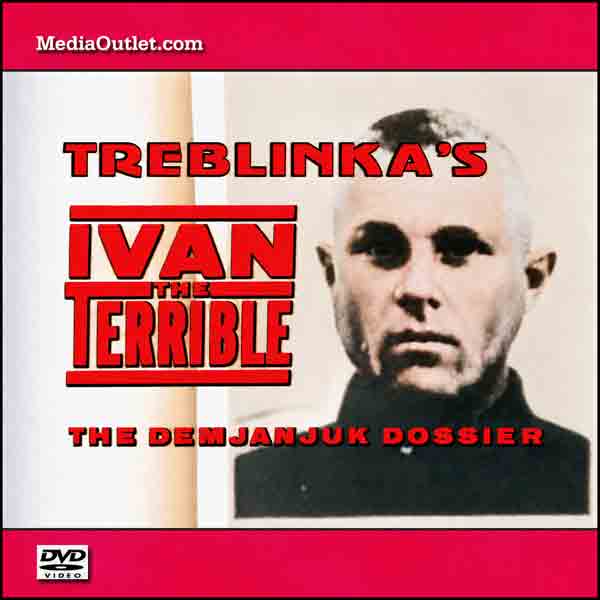
August 2, 1943: The European Civil War:
World War II: The Second European War (The European Theater Of
World War II): The Holocaust (Shoah): The Holocaust In Poland:
Treblinka Extermination Camp: The Treblinka Prisoner Uprising: --
At 3:45 p.m on a hot summer Monday, a regular day of rest from
gassing, when a group of Germans and 40 Ukrainians drove off to
the River Bug to swim, 700 Jewish prisoners launch a prisonder
revolt at Treblinka Extermination Camp, one of the deadliest of
Nazi concentration death camps where approximately 900,000 persons
were murdered in less than 18 months, in an insurgency that lasted
for 30 minutes. The conspirators silently unlocked the door to the
arsenal near the train tracks, with a key that had been duplicated
earlier. They had stolen 20-25 rifles, 20 hand grenades, and
several pistols, and delivered them in a cart to the gravel work
detail. They set buildings ablaze, exploded a tank of petrol, and
set fire to the surrounding structures. A group of armed Jews
attacked the main gate, and others attempted to climb the fence.
Machine-gun fire from about 25 Germans and 60 Ukrainian Trawnikis
resulted in near-total slaughter. Their leader, former Polish Army
officer Dr. Berek Lajcher was killed along with most of the
insurgents. About 200 Jews escaped from the camp. Half of them
were killed after a chase in cars and on horses. The Jews did not
cut the phone wires, and Stangl called in hundreds of German
reinforcements, who arrived from four different towns and set up
roadblocks along the way. Partisans of the Armia Krajowa (Polish:
Home Army) transported some of the surviving escapees across the
river and others like revolt organizer Hershl Sperling ran 30
kilometres (19 miles) and were then helped and fed by Polish
villagers. Of those who broke through, around 70 are known to have
survived until the end of the war, including the future authors of
published Treblinka memoirs: Richard Glazar, Chil Rajchman,
Jankiel Wiernik, and Samuel Willenberg. In early 1943, an
underground Jewish resistance organisation was formed at Treblinka
with the goal of seizing control of the camp and escaping to
freedom. The planned revolt was preceded by a long period of
secret preparations. The clandestine unit was first organised by a
former Jewish captain of the Polish Army, Dr. Julian Chorazycki,
who was described by fellow plotter Samuel Rajzman as noble and
essential to the action. His organising committee included Zelomir
Bloch (leadership), Rudolf Masaryk, Marceli Galewski, Samuel
Rajzman, Dr. Irena Lewkowska ("Irka", from the sick bay
for the Hiwis), Leon Haberman, Chaim Sztajer, Hershl (Henry)
Sperling from Czestochowa, and several others. Chorazycki (who
treated the German patients) killed himself with poison on 19
April 1943 when faced with imminent capture, so that the Germans
could not discover the plot by torturing him. The next leader was
another former Polish Army officer, Dr. Berek Lajcher, who arrived
on 1 May. Born in Czestochowa, he had practised medicine in
Wyszkow and was expelled by the Nazis to Wegrow in 1939. The
initial date of the revolt was set for 15 June 1943, but it had to
be postponed. A fighter smuggled a grenade in one of the early May
trains carrying captured rebels from the Warsaw Ghetto Uprising,
which had begun on 19 April 1943. When he detonated it in the
undressing area, the SS and guards were thrown into a panic. After
the explosion, Treblinka received only about 7,000 Jews from the
capital for fear of similar incidents; the remaining 42,000 Warsaw
Jews were deported to Majdanek, instead. The burning of unearthed
corpses continued at full speed until the end of July. The
Treblinka II conspirators became increasingly concerned about
their future as the amount of work for them began to decline. With
fewer transports arriving, they realised "they were next in
line for the gas chambers." On Sale Until Midnight Tonight
PT!
https://store.earthstation1.com/trebilinka39s-iva-the-terrible-the-demjanjuk-dossier-d39.html
Today's
EarthStation1.com 15% (Or More!) Off Commemorative Memorial Title:
James Baldwin: The Price of the Ticket DVD, Video Download, USB
Drive
Today, August 2, 2026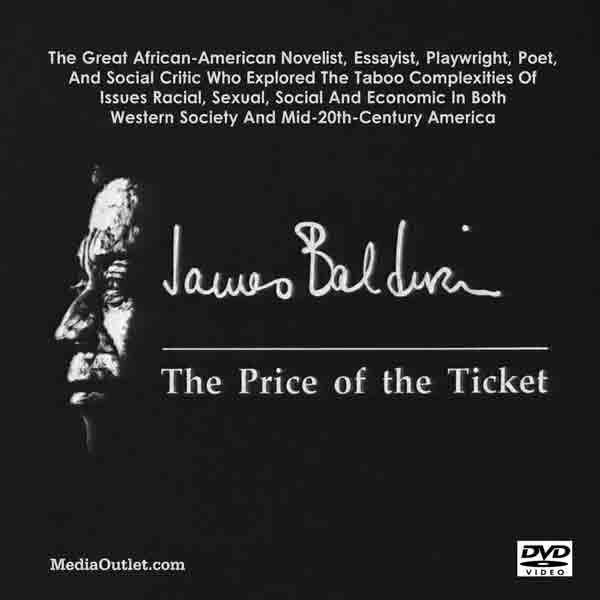
August 2, 1924: #BOTD: #HBD! James
Baldwin, African American novelist and social critic (d. December
1, 1987) is #born James Arthur Baldwin at Harlem Hospital in New
York City. James Baldwin's essays, as collected in Notes Of A
Native Son (1955), explore intricacies of racial, sexual, and
class distinctions in Western societies, most notably in
mid-20th-century America. Some of Baldwin's essays are
book-length, including The Fire Next Time (1963), No Name in the
Street (1972), and The Devil Finds Work (1976). An unfinished
manuscript, Remember This House, was expanded and adapted for
cinema as the Academy Award-nominated documentary film I Am Not
Your Negro. Baldwin's novels and plays fictionalize fundamental
personal questions and dilemmas amid complex social and
psychological pressures thwarting the equitable integration not
only of African Americans, but also of gay and bisexual men, while
depicting some internalized obstacles to such individuals' quests
for acceptance. Such dynamics are prominent in Baldwin's second
novel, Giovanni's Room, written in 1956, well before the gay
liberation movement. James Baldwin died from stomach cancer in
Saint-Paul-de-Vence, France, aged 63. He is buried at the
Ferncliff Cemetery in Hartsdale, near New York City. On Sale Until
Midnight Tonight PT!
https://store.earthstation1.com/james-baldwin-the-price-of-the-ticket-dvd.html
Today's
EarthStation1.com 15% (Or More!) Off Commemorative Memorial Title:
America: The Way We Were: The Home Front 1940-1945 DVD, Download,
USB
Today, August 2, 2026
August 1-2, 1943: World War II: The Home
Front During World War II: The United States Home Front During
World War II: Race Riots: Race Riots In The United States: The
Harlem Riot Of 1943: -- A two-day riot ends in Harlem, New York
City after a white police officer, James Collins, shot and wounded
Robert Bandy, an African American soldier; and rumors circulated
that the soldier had been killed. The riot was chiefly directed by
Black residents against white-owned property in Harlem. It was one
of five riots in the nation that year related to Black and white
tensions during World War II. The others took place in Detroit;
Beaumont, Texas; Mobile, Alabama; and Los Angeles. In Harlem,
Bandy had witnessed a Black woman's arrest for disorderly conduct
in a hotel and sought to have her released. According to the
police, Bandy hit the officer, who shot the soldier as he was
trying to flee from the scene. A crowd of about 3,000 people
gathered at police headquarters after a smaller crowd had followed
Bandy and the officer to a hospital for treatment. When someone in
the crowd at police headquarters incorrectly stated that Bandy had
been killed, a riot ensued in the community that lasted for two
days and resulted in six deaths and hundreds injured, with nearly
600 arrests. The riot had a pattern mostly of vandalism, theft,
and property destruction of white-owned businesses in Harlem,
resulting in monetary damages, rather than attacks on persons. New
York City Mayor Fiorello H. La Guardia ultimately restored order
in the borough on August 2 with the recruitment of several
thousand officers and volunteer forces to contain the rioters.
City units cleaned up and repaired buildings. The mayor also
supplied food and goods afterward to compensate for the closed
businesses. The underlying causes of the riot stemmed from
resentment among Black residents of Harlem of the disparity
between the vaunted values of American democracy and the social
and economic conditions they were forced to live under, including
brutality and discriminatory treatment by the mostly white city
police force. They resented the segregation of Black troops
serving with the United States, and wartime shortages created more
difficult conditions in Harlem housing and supplies. African
Americans suffered discriminatory practices in civil and private
employment, and city services, which created tension as they tried
to improve their lives. Bandy symbolized the Black soldiers who
were segregated in the Army, even as the United States promoted
the national fight for 'freedom.' Collins represented the white
discrimination and suppression Black residents had to deal with on
a daily basis. The riot became a subject of art and literature: it
inspired the "theatrical climax" of Ralph Ellison's
novel Invisible Man, winner of the 1953 National Book Award, it
frames the events recounted in James Baldwin's memoirs Notes of a
Native Son, and it appears in artist William Johnson's painting
Moon Over Harlem. On Sale Until Midnight Tonight PT!
https://store.earthstation1.com/america-the-way-we-were-the-home-front-19401945-life-and-cu19401945.html
Today's
EarthStation1.com 15% (Or More!) Off Commemorative Memorial Title:
Eyes On The Prize II: America At The Racial Crossroads DVD MP4 USB
Today, August 2, 2026
August 2, 1964: Civil Rights Movements:
The American Civil Rights Movement (1954-1968): The Ghetto Riots
(The Ghetto Rebellions, The Race Riots, The Negro Riots)
(1964-1969): The Jersey City Riot Of 1964 (The 1964 Jersey City
Uprising): -- The 1964 Jersey City, New Jersey uprising begins the
evening of August 2 and lasted three nights until the morning of
August 5. The uprising began in the predominantly black
neighborhood of Lafayette in Jersey City after police arrested
26-year-old African American Delores Shannon for disorderly
conduct and being drunk in public. Another African American,
34-year-old Walter Mays, attempted to intervene in Shannon's
arrest and was himself arrested. The arrests of Shannon and Mays
initiated the uprising. Witnesses immediately began accusing the
police of brutality, and violence broke out between groups of
black youths -- carrying bottles, rocks, clubs, and "gasoline
bombs" -- and the police. An estimated 800 African Americans
looted, threw rocks at passing vehicles, and attempted to pull
people out of cars during the first night of the riot.
Approximately 150 police armed with shotguns and .38 caliber
handguns were dispatched to end the rioting. Thirty people,
including 10 police officers, were injured. Three white people
were injured after being pulled from their cars and beaten. Jersey
City Mayor Thomas J. Whelan took a hardline stance against the
"young thugs" he held responsible for the violence and
promised to crush the uprising. Whelan's tough, no-nonsense
approach brought praise from President Lyndon Johnson and New
Jersey Governor Richard J. Hughes. Rioting continued on August 3
as Jersey City Councilman Fred Martin, Congress of Racial Equality
(CORE) chairman John Bell, NAACP president Julian Robinson and
local clergymen met with city officials including Mayor Whelan.
Arguing that a long history of neglect, abuse, and
disenfranchisement of the African American community had led to
the outbreak of the rioting, the community leaders asked the mayor
to improve recreational facilities for black youth, hire more
black policemen, and provide more employment opportunities for
black people throughout the city. The meeting lasted 26 minutes
but Whelan and the community leaders could not come to any
agreement on how to move forward. Living conditions and job
opportunities for all in the city were poor and, according to
Whelan, the city was not in financial shape to promise any
sweeping changes. Whelan also claimed that the riot was the fault
of a small minority of black youth and not a symptom of long term
socioeconomic problems within the city. By the evening of August
4, over 400 police officers attempted to stop the rioting. At the
same time, local clergymen drove through neighborhoods asking for
an end to the violence and letting people know that one of the
demands by the protesters had been met, two local parks were going
to be re-opened. Rioting ended on August 5. At least 46 people
were reported injured, 52 people were arrested and 71 stores and
businesses were damaged. On Sale Until Midnight Tonight PT!
https://store.earthstation1.com/eyes-on-the-prize-ii-dvd-set-4-discs-complete-2nd-seri42.html
Today's
EarthStation1.com 15% (Or More!) Off Commemorative Memorial Title:
The Birth Of The Bomb: The Manhattan Project DVD, Download, USB
Drive
Today, August 2, 2026
August 2, 1939: The European Civil War:
World War II: The Second European War (The European Theater Of
World War II): Nuclear Weapons Programs Of The United States: The
Manhattan Project (Codename: Development Of Substitute Materials):
The Einstein-Szilard Letter: -- A letter is written by Leo Szilard
in consultation with fellow Hungarian physicists Edward Teller and
Eugene Wigner that is signed by Albert Einstein and sent to the
United States President Franklin D. Roosevelt concerning the
possibility of atomic weapons. The letter warned that Germany
might develop atomic bombs, and suggested that the United States
should start its own nuclear program. It prompted action by
Roosevelt, which eventually resulted in the Manhattan Project
developing the first atomic bombs. "A single bomb of this
type carried by boat and exploded in a port, might very well
destroy the whole port together with some of the surrounding
territory." Six years later, on August 6, 1945, the first
atomic bomb, developed by the U.S., was dropped on the Japanese
port of Hiroshima. On Sale Until Midnight Tonight PT!
https://store.earthstation1.com/the-birth-of-the-bomb-dvd-the-race-to-build-first-atom-bomb.html
Today's
EarthStation1.com 15% (Or More!) Off Commemorative Memorial Title:
Marihuana (1936) Anti-Drug Propaganda Film DVD, Download, USB
Drive
Today, August 2, 2026
August 2, 1937: Drugs: Recreational
Drugs: Psychoactive Drugs: Cannabis (Pot, Marijuana, Marihuana,
Mary Jane, Weed, Reefer): Cannabis Law: Cannabis Law In The United
States: The Marihuana Tax Act Of 1937, Pub.L. 75-238, 50 Stat.
551: -- The Marihuana Tax Act Of 1937 is signed into law by
President Franklin D. Roosevelt and thereby enacted, which
effectively, though not directly, rendered marijuana and all its
by-products illegal. The act had been introduced in the House of
Representatives on May 11, 1937 and passd on June 14 that year.
The Marihuana TaxAct of 1937, Pub.L. 75-238, 50 Stat. 551 was a
United States Act that placed a tax on the sale of cannabis. The
H.R. 6385 act was drafted by Harry Anslinger and introduced by
Rep. Robert L. Doughton of North Carolina, on April 14, 1937. The
seventy-fifth Congress held hearings on April 27, 28, 29th, 30th,
and May 4, 1937. Upon the congressional hearings confirmation, the
H.R. 6385 act was redrafted as H.R. 6906 and introduced with House
Report 792. The Act is now commonly referred to, using the modern
spelling, as the 1937 Marijuana TaxAct. This act was overturned in
1969 in Leary v. United States, and was repealed by Congress the
next year. Regulations and restrictions on the sale of cannabis
sativa as a drug began as early as 1906 (see Legal history of
cannabis in the United States). The head of the Federal Bureau of
Narcotics (FBN), Harry J. Anslinger, argued that, in the 1930s,
the FBN had noticed an increase of reports of people smoking
marijuana. He had also, in 1935, received support from president
Franklin D. Roosevelt for adoption of the Uniform State
NarcoticAct, state laws that included regulations of cannabis. It
has long been argued that the aim of the Act was to reduce the
size of the hemp industry, largely as an effort of businessmen
Andrew Mellon, Randolph Hearst, and the Du Pont family. The
invention of the decorticator, a machine for stripping the skin,
bark, or rind off nuts, wood, plant stalks, grain, etc., in
preparation for further processing. had made hemp become a very
cheap substitute for the paper pulp that was used in the newspaper
industry. It has been asserted that Hearst felt that this was a
threat to his extensive timber holdings. Mellon, Secretary of the
Treasury and the wealthiest man in the US, had invested heavily in
the Du Pont family's new synthetic fiber, nylon, a fiber that was
competing with hemp. In 1916, United States Department of
Agriculture (USDA) chief scientists Jason L. Merrill and Lyster H.
Dewey created a paper, USDA Bulletin No. 404 "Hemp Hurds as
Paper-Making Material", in which they concluded that paper
from the woody inner portion of the hemp stem broken into pieces,
so called hemp hurds, was "favorable in comparison with those
used with pulp wood". Until 1883, 75% to 90% of all paper in
the world was made from cannabis hemp fiber. Famous writings
written on hemp paper include The Gutenberg Bible (15th century);
The King James Bible (17th century); the Thomas Paine's pamphlets
The Rights of Man, Common Sense, and The Age of Reason; The
American Declaration Of Independence; The works of Mark Twain,
Alexander Dumas, and Victor Hugo; and Lewis Carroll's beloved
Alice In Wonderland; all these were written on hemp paper, as was
just about everything else at the time. The DuPont Company and
many industrial historians dispute a link between nylon and hemp.
They argue that the purpose of developing the nylon was to produce
a fiber that could compete with silk and rayon. The American
Medical Association (AMA) opposed the act because the tax was
imposed on physicians prescribing cannabis, retail pharmacists
selling cannabis, and medical cannabis cultivation/manufacturing.
The AMA proposed that cannabis instead be added to the Harrison
Narcotics TaxAct. The bill was passed over the last-minute
objections of the American Medical Association. Dr. William
Creighton Woodward, legislative counsel for the AMA objected to
the bill on the grounds that the bill had been prepared in secret
without giving proper time to prepare their opposition to the
bill. He doubted their claims about marijuana addiction, violence,
and overdosage; he further asserted that because the word
Marijuana was largely unknown at the time, the medical profession
did not realize they were losing cannabis. "Marijuana is not
the correct term ... Yet the burden of this bill is placed heavily
on the doctors and pharmacists of this country." The bill was
passed on the grounds of different reports and hearings; Anslinger
referred to the International Opium Convention that from 1928
included cannabis as a drug not a medicine, and that all states
had some kind of laws against improper use of cannabis (for ex.
the Uniform State NarcoticAct). By 1951, however, new
justifications had emerged, and the BoggsAct that superseded the
Marihuana TaxAct of 1937 was passed. In August 1954, the Internal
Revenue Code of 1954 was enacted, and the Marihuana TaxAct was
included in Subchapter A of Chapter 39 of the 1954 Code. Shortly
after the 1937 Marihuana TaxAct went into effect on October 1,
1937, the Federal Bureau of Narcotics and Denver City police
arrested Moses Baca for possession and Samuel Caldwell for
dealing. Baca and Caldwell's arrest made them the first marijuana
convictions under U.S. federal law for not paying the marijuana
tax. Judge Foster Symes sentenced Baca to 18 months and Caldwell
to four years in Leavenworth Penitentiary for violating the 1937
Marihuana TaxAct. After the Philippines fell to Japanese forces in
1942, the Department of Agriculture and the US Army urged farmers
to grow fiber hemp. Most parachutes manufactured by America during
World War II were made of hemp. Tax stamps for cultivation of
fiber hemp began to be issued to farmers. Without any change in
the Marihuana TaxAct, 400,000 acres (1,600 km2) were cultivated
with hemp between 1942 and 1945. The last commercial hemp fields
were planted in Wisconsin in 1957. In 1967, President Johnson's
Commission on Law Enforcement and Administration of Justice
opened, "The Act raises an insignificant amount of revenue
and exposes an insignificant number of marijuana transactions to
public view, since only a handful of people are registered under
the Act. It has become, in effect, solely a criminal law, imposing
sanctions upon persons who sell, acquire, or possess marijuana."
In 1969 in Leary v. United States, part of the Act was ruled to be
unconstitutional as a violation of the Fifth Amendment, since a
person seeking the tax stamp would have to incriminate
him/herself. In response the Congress passed the Controlled
Substances Act as Title II of the Comprehensive Drug Abuse
Prevention and Control Act of 1970, which repealed the 1937 Act.
On Sale Until Midnight Tonight PT!
https://store.earthstation1.com/marihuana-dvd-1936-antidrug-1936.html
Today's
EarthStation1.com 15% (Or More!) Off Commemorative Memorial Title:
In The Suburbs: Life In Suburbia Films DVD, Video Download, USB
Drive
Today, August 2, 2026
August 2, 1929: The Aftermath Of World
War II: Suburbia: Housing Projects: Planned Communities: Planned
Communities In The United Stattes: Redlining: Levittowns: --
Levitt & Sons, Inc. is founded by Abraham Levitt, which built
Levittowns as planned communities for returning white World War II
veterans between 1947 and 1951. Levitt & Sons was a real
estate development company founded by Abraham Levitt and later
managed by his son William Levitt. The company is most famous for
having built the town of Levittown, New York. The company's
designs and building practices revolutionized the home building
industry and altered the north eastern landscape of the United
States with massive suburban communities. Levitt & Sons was
America's biggest home builder by 1951, and William Levitt was
named one of the 100 most influential people of the 20th century.
Historian Kenneth T. Jackson wrote of Levitt & Sons, "The
family that had the greatest impact on postwar housing in the
United States was Abraham Levitt and his sons, William and Alfred,
who ultimately built more than 140,000 houses and turned a cottage
industry into a major manufacturing process." On Sale Until
Midnight Tonight PT!
https://store.earthstation1.com/in-the-suburbs-life-in-suburbia-films-dvd.html
Today's
EarthStation1.com 15% (Or More!) Off Commemorative Memorial Title:
John F. Kennedy: Years Of Lightning, Day Of Drums DVD, Download,
USB
Today, August 2, 2026
August 2, 1943: World War II: The Pacific
War (The Asia-Pacific War, The Pacific Theater Of World War II):
The Pacific Ocean Theater Of World War II: Operation Cartwheel:
The Solomon Islands Campaign: The Battle Of Blackett Strait (July
1943): Patrol Torpedo Boat PT-109: -- The Japanese destroyer
Amagiri rams and sinks PT-109, commanded by Lt. John F. Kennedy,
future U.S. President, who saves all but two of his crew, earned
him The Navy And Marine Corps Medal for his heroism -- the highest
non-combat decoration awarded for heroism by the United States
Department of the Navy to members of the United States Navy and
United States Marine Corps -- and a Purple Heart for injuries he
sustained in the collision, despite these injuries apparently not
having been publicly disclosed beyond aggravating his health
issues (it contributed to his back problems, until his symptoms
eventually progressed to a point where they were incapacitating;
the incident also contributed to his gastrointestinal problems; he
is the only U.S. president to have earned either of those honors.
Around 2 a.m., on a moonless night with fog, Kennedy's PT-109
traveled along with PT-169 and PT-162. Kennedy's boat was idling
on one engine to avoid detection of her wake by Japanese aircraft
when the crew realized they were in the path of the Japanese
destroyer Amagiri, which was returning to the Japanese naval base
at Rabaul in Papua New Guinea from Vila Plantation in the Solomon
Island of Kolombangara, after having offloaded supplies and 900
soldiers. Contemporary accounts of the incident, particularly the
work of Mark Doyle, do not conclude that the sole cause of the
collision was the idling engines of the 109. Amagiri was traveling
at a relatively high speed of between 23 and 40 knots (43 and 74
km/h; 26 and 46 mph) in order to reach harbor by dawn, when Allied
air patrols were likely to appear. PT-109's crew had less than ten
seconds to get the engines up to speed and evade the oncoming
destroyer, but were run down and severed in half between the
Solomon Islands of Kolombangara and Ghizo Island. Conflicting
statements have been made as to whether the destroyer captain had
spotted and steered towards the boat. Some reports suggest
Amagiri's Captain never realized what happened until after the
fact. The author Donovan, having interviewed the men on the
destroyer, concluded that it was not an accident. Damage to a
propeller slowed the Japanese destroyer's trip to her own home
base. Mark Doyle concluded that a burst of fire from the Amagiri's
rear guns after the collision indicated they had intended to ram
the 109, and a Japanese newspaper one week later described the
collision as intentional. The captain of Amagiri was Lieutenant
Commander Kohei Hanami. Also aboard was his senior officer,
Captain Katsumori Yamashiro (commander, 11th Destroyer Flotilla),
and on a following ship was Captain Tameichi Hara (Flotilla
commander, Destroyer Div. #7), who claimed he noticed the
resulting explosive fire after PT-109 had been rammed, cut in
half, and left burning. PT-109 was cut in two. Seamen Andrew
Jackson Kirksey and Harold W. Marney were killed instantly, and
two other members of the crew were badly injured. For such a
catastrophic collision, explosion, and fire, there were few men
lost when contrasted to the losses on other PT boats hit by shell
fire. PT-109 was gravely damaged, with watertight compartments
keeping only the forward hull afloat in a sea of flames. PT-169
launched two torpedoes that missed the destroyer and PT-162's
torpedoes failed to fire at all. Both boats then turned away from
the scene of the action and returned to base without checking for
survivors from the PT-109. On orders from Kennedy, the eleven
survivors, first regrouped, and then clung to PT-109's bow section
as it drifted slowly south. By about 2 p.m., it was apparent that
the hull was taking on water and would soon sink, so the men
decided to swim for land. As there were Japanese camps on all the
nearby large islands, they chose the tiny deserted Plum Pudding
Island three and a half miles southwest of the wreck of the
PT-109, and Southwest of Kolombangara. They placed their lantern,
shoes, and non-swimmers on one of the timbers that had been used
as a gun mount and began kicking together to propel it. Kennedy,
who had been on the Harvard University and Choate swim teams, used
a life jacket strap clenched between his teeth to tow his badly
burned senior enlisted machinist mate, MM1 Patrick McMahon. It
took four hours to swim to the island, 3.5 miles (5.6 km) away,
which they reached without disturbing the resident sharks or
crocodiles. Plum Pudding island was only 100 yards (91 m) in
diameter, with no food or water. The crew had to hide from passing
Japanese barges. Kennedy made an additional two mile swim the
night of August 2, 1943, to Ferguson Passage to attempt to hail a
passing American PT boat to expedite his crew's rescue. Kennedy
later swam to Olasana and then Naru islands, a round trip of about
2.5 miles (4.0 km), in search of help and food. Returning to Plum
Pudding Island, on August 4, he and Lenny Thom assisted his
injured and hungry crew on a demanding swim one and three quarter
miles Southwest to Olasana Island, which had more ripe coconut
trees, but only small amounts of drinkable water. The explosion on
the early morning of 2 August was spotted by an Australian
coastwatcher, Sub-lieutenant Arthur Reginald Evans, who manned a
secret observation post at the top of the Mount Veve volcano on
Kolombangara, where more than 10,000 Japanese troops were
garrisoned below on the southeast portion. The Navy and its
squadron of PT boats held a memorial service for the crew of
PT-109 after reports were made of the large explosion, but still
ordered an aerial search by American P-40 fighters that spotted a
few remains of the wreck, but not the crew. It was Evans who
dispatched islanders Biuku Gasa and Eroni Kumana in a dugout canoe
to look for possible survivors after decoding radio broadcasts
that the explosion he had witnessed was from the lost PT-109. Gasa
and Kumana had been trained by the British in search and detection
and were willing to sacrifice their lives as part of their duty to
the British and American troops. Evans assumed Gasa and Kumana
could avoid detection by Japanese ships and aircraft and, if
spotted, would probably be taken for native fishermen. Before they
were found by the scouts, Kennedy and his men survived for six
days on Olasana Island. They had only a few ripe coconuts, and
small amounts of fresh water and Japanese cookies taken from Naru
Island, one mile South, found earlier during a swim made by
Kennedy and Thom. Gasa and Kumana disobeyed an order, stopping by
Naru to investigate a Japanese wreck, from which they salvaged
fuel and food. They first fled by canoe from Kennedy, who with his
sunburn, beard, and disheveled clothing appeared to them to be a
Japanese soldier. On Olasana, they pointed their Tommy guns at the
rest of the crew, since the only light-skinned people they
expected to find were Japanese with whom they could not
communicate. Gasa later said, "All white people looked the
same to me." Ensign Thom convinced the coastwatcher scouts
that he and his crew were Americans when he inquired of Gasa if he
knew Reginald Evans and received a positive response. Though the
1963 movie depicted Kennedy offering a coconut inscribed with a
message as his idea and the soul form of communication, according
to a National Geographic interview, it was Gasa who suggested it
and Kumana who climbed a coconut tree to pick one. On the
instructions of Gaza, Kennedy painstakingly scratched the
following message on the coconut husk with a knife (the coconut
with the carved message was later cast in a paperweight):
========= "NAURO ISL COMMANDER... NATIVE KNOWS POS'IT... HE
CAN PILOT... 11 ALIVE NEED SMALL BOAT... KENNEDY" =========
Kennedy told Gasa and Kumana, "If Japan man comes, scratch
out the message." The message was delivered to the base at
Rendova at great risk by Gasa and Kumana in record time by
paddling their canoe through 35 nmi (65 km; 40 mi) of hostile
waters patrolled by the Japanese. Other coastwatcher natives who
were caught aiding the allies had been tortured and killed. Later,
a canoe returned for Kennedy, taking him to the coastwatcher
Reginald Evans now on Gomu Island to coordinate the rescue.
PT-157, commanded by Lieutenant William Liebenow, experienced and
familiar with the area, motored from Rendova, and picked up
Kennedy on Reginald Evan's base at Gomu. He then rescued the
surviving crew members on Olasana Island on August 8, returning
the full crew and the coastwatcher scouts to the Rendova PT base.
The arranged signal when picking up Kennedy on Gomu was four
shots, but since Kennedy only had three bullets in his pistol,
Evans gave him a Japanese rifle for the fourth signal shot. The
sailors sang "Yes Jesus Loves Me" once aboard PT-157 to
pass the time. Gasa and Kumana received little notice or credit in
military reports, books, or movies until 2002, when they were
interviewed by National Geographic shortly before Gasa's death,
but Kennedy thanked them profusely after the rescue and admitted
he owed his life to their efforts. In a more recent visit to the
area, writer/photographer Jad Davenport managed to track down the
then-90-year-old Eroni Kumana, and together they made a visit to
view Kennedy Island. Kumana recounted that the first thing the
survivors asked for was cigarettes. When they realized they had no
matches, Kumana surprised and delighted the men by rubbing two
sticks together to start a fire. The coconut shell came into the
possession of Ernest W. Gibson, Jr., who was serving in the South
Pacific with the 43rd Infantry Division. Gibson later returned it
to Kennedy. Kennedy preserved it in a glass paperweight on his
Oval Office desk during his presidency. It is now on display at
the John F. Kennedy Library in Boston, Massachusetts. Thom and
Kennedy were both awarded the Navy and Marine Corps Medal. Kennedy
was also awarded the Purple Heart for injuries he sustained in the
collision. Following their rescue, Thom was assigned as commander
of PT-587 and Kennedy was assigned as commander of PT-59 (a.k.a.
PTGB-1). Kennedy and Thom remained friends, and when Thom died in
a 1946 car accident, Kennedy was one of his pallbearers. On Sale
Until Midnight Tonight PT!
https://store.earthstation1.com/john-f-kennedy-years-of-lightning-day-of-drums-dvd.html
Today's
EarthStation1.com 15% (Or More!) Off Commemorative Memorial Title:
My Wicked, Wicked Ways The Legend Of Errol Flynn Docudrama DVD MP4
USB
Today, August 2, 2026
August 2, 1892: #BOTD: #HBD! Jack L.
Warner, Canadian-born American production manager and producer,
co-founder of Warner Bros. (d. September 9, 1978) is #born Jacob
Warner in London, Ontario. Jack Leonard "J. L." Warner
was a Jewish Canadian-American film executive who was the
president and driving force behind the Warner Bros. Studios in
Burbank, California. Warner's career spanned some 45 years, its
duration surpassing that of any other of the seminal Hollywood
studio moguls. As co-head of production at Warner Bros. Studios,
he worked with his brother, Sam Warner, to procure the technology
for the film industry's first talking picture. After Sam's death,
Jack clashed with his surviving older brothers, Harry and Albert
Warner. He assumed exclusive control of the film production
company in the 1950s, when he secretly purchased his brothers'
shares in the business after convincing them to participate in a
joint sale of stocks. Although Warner was feared by many of his
employees and inspired ridicule with his uneven attempts at humor,
he earned respect for his shrewd instincts and tough-mindedness.
He recruited many of Warner Bros.' top stars and promoted the
hard-edged social dramas for which the studio became known. Given
to decisiveness, Warner once commented, "If I'm right
fifty-one percent of the time, I'm ahead of the game."
Throughout his career, he was viewed as a contradictory and
enigmatic figure. Although he was a staunch Republican, Warner
encouraged film projects that promoted the agenda of Democratic
President Franklin D. Roosevelt's New Deal. He opposed European
fascism and criticized Nazi Germany well before America's
involvement in World War II. An opponent of Communism, after the
war Warner appeared as a friendly witness before the House
Un-American Activities Committee, voluntarily naming screenwriters
who had been fired as suspected Communists or sympathizers.
Despite his controversial public image, Warner remained a force in
the motion picture industry until his retirement in the early
1970s. Jack L. Warner died at Cedars-Sinai Hospital of heart
inflammation (edema), aged 86 years old. A funeral service was
held at the Wilshire Boulevard Temple, the synagogue to which many
members of the Warner family belonged. He was interred at Home of
Peace Cemetery in East Los Angeles, California. On Sale Until
Midnight Tonight PT!
https://store.earthstation1.com/my-wicked-wicked-ways-the-legend-of-errol-flynn-dvd-2-disc2.html
Today's
EarthStation1.com 15% (Or More!) Off Commemorative Memorial Title:
Clive James' Fame In The 20th Century TV Series DVD Set MP4 USB
Drive
Today, August 2, 2026
August 2, 1932: #BOTD: #HBD! Peter
O'Toole, British English Irish stage and film actor and producer
(d. December 14, 2013) is #born Peter Seamus O'Toole at St James's
University Hospital (sic) in Leeds, West Riding of Yorkshire,
England. He attended the Royal Academy of Dramatic Art and began
working in the theatre, gaining recognition as a Shakespearean
actor at the Bristol Old Vic and with the English Stage Company.
In 1959 he made his West End debut in The Long and the Short and
the Tall, and played the title role in Hamlet in the National
Theatre's first production in 1963. Excelling on the London stage,
O'Toole was known for his "hellraiser" lifestyle off it.
Making his film debut in 1959, O'Toole achieved international
recognition playing T. E. Lawrence in Lawrence of Arabia (1962)
for which he received his first nomination for the Academy Award
for Best Actor. He was nominated for this award another seven
times - for playing King Henry II in both Becket (1964) and The
Lion in Winter (1968), Goodbye, Mr. Chips (1969), The Ruling Class
(1972), The Stunt Man (1980), My Favorite Year (1982), and Venus
(2006) - and holds the record for the most Oscar nominations for
acting without a win (tied with Glenn Close). In 2002, he was
awarded the Academy Honorary Award for his career achievements.
O'Toole was the recipient of four Golden Globe Awards, one BAFTA
Award for Best British Actor and one Primetime Emmy Award. Other
performances include What's New Pussycat? (1965), How to Steal a
Million (1966), Supergirl (1984), and minor roles in The Last
Emperor (1987) and Troy (2004). He also voiced Anton Ego, the
restaurant critic in Pixar's Ratatouille (2007). Peter O'Toole
died of stomach cancer at Wellington Hospital in St John's Wood,
London, at the age of 81. His funeral was held at Golders Green
Crematorium in London on December 21, 2013, where his body was
cremated in a wicker coffin. His family stated their intention to
fulfil his wishes and take his ashes to the west of Ireland. On
Sale Until Midnight Tonight PT!
https://store.earthstation1.com/clive-james39-fame-in-the-20th-century-tv-series-dvd-set-mp4-usb-39204.html
Today's
EarthStation1.com 15% (Or More!) Off Commemorative Memorial Title:
The Golden Age Of Comedy 5 Album Set CD, MP3, USB Stick
Today, August 2, 2026
August 2, 1890: #BOTD: #HBD! Bob Burns,
American musical comedian, who appeared on radio and in movies
from 1930 to 1947 (d. February 2, 1956) is #born Robin Burns in
Greenwood, Arkansas, Bob Burns played a novelty musical instrument
he invented in the in the 1910s, which he called a "bazooka",
a length of gas pipe one blew into it, creating an unusual sound.
With modifications, this became a musical instrument he named
"bazooka" after "bazoo", slang for "mouth"
or "boastful talk" which refers to a "windbag"
of person, from the Dutch "bazuin" for "trumpet".
Functioning like a crude trombone, the musical bazooka had a
narrow range, but this was intentional. Burns popularized it in
the 1930s, and it was also played by jazz musicians Noon Johnson
and Sanford Kendrick. During World War II, the US Army's handheld
anti-tank rocket launcher was nicknamed the "bazooka".
Bob Burns died from kidney cancer in Encino, Los Angeles,
California at the age of 65. His burial details are not publicly
available. On Sale Until Midnight Tonight PT!
https://store.earthstation1.com/golden-age-of-comedy-narrated-by-george-burns-5-album-set-mp3-53.html
Today's
EarthStation1.com 15% (Or More!) Off Commemorative Memorial Title:
Napoleon's Last Battle: The Memorial Of Saint Helena MP4 Download
DVD
Today, August 2, 2026
August 2, 1798: The Age Of Enlightenment
(The Enlightenment, The Age Of Reason): The Age Of Revolution: The
Atlantic Revolutions: The French Revolution: The French
Revolutionary And Napoleonic Wars (The Great French War) (The
French Revolutionary Wars, The Napoleonic Wars): The Napoleonic
Wars: The French Invasion Of Egypt And Syria: The Mediterranean
Campaign Of 1798: The Battle Of The Nile (The Battle Of Aboukir
Bay [French: Bataille d'Aboukir]): -- A British Royal Navy fleet
led by Rear-Admiral Sir Horatio Nelson decisively defeat a French
Republic Navy fleet led by Vice-Admiral Francois-Paul Brueys
d'Aigalliers in a major naval battle at Aboukir Bay on the
Mediterranean coast off the Nile Delta of Egypt from August 1 to
3, 1798, the climax of a naval campaign that had ranged across the
Mediterranean during the previous three months as a large French
convoy sailed from Toulon to Alexandria carrying an expeditionary
force under General Napoleon Bonaparte. Bonaparte sought to invade
Egypt as the first step in a campaign against British India, part
of a greater effort to drive Britain out of the French
Revolutionary Wars. As Bonaparte's fleet crossed the
Mediterranean, it was pursued by a British force under Nelson who
had been sent from the British fleet in the Tagus to learn the
purpose of the French expedition and to defeat it. He chased the
French for more than two months, on several occasions missing them
only by a matter of hours. Bonaparte was aware of Nelson's pursuit
and enforced absolute secrecy about his destination. He was able
to capture Malta and then land in Egypt without interception by
the British naval forces. With the French army ashore, the French
fleet anchored in Aboukir Bay, 20 miles (32 km) northeast of
Alexandria. Commander Vice-Admiral Francois-Paul Brueys
d'Aigalliers believed that he had established a formidable
defensive position. The British fleet arrived off Egypt on August
1 and discovered Brueys's dispositions, and Nelson ordered an
immediate attack. His ships advanced on the French line and split
into two divisions as they approached. One cut across the head of
the line and passed between the anchored French and the shore,
while the other engaged the seaward side of the French fleet.
Trapped in a crossfire, the leading French warships were battered
into surrender during a fierce three-hour battle, while the centre
succeeded in repelling the initial British attack. As British
reinforcements arrived, the centre came under renewed assault and,
at 22:00, the French flagship Orient exploded. The rear division
of the French fleet attempted to break out of the bay, with Brueys
dead and his vanguard and centre defeated, but only two ships of
the line and two frigates escaped from a total of 17 ships
engaged. The battle reversed the strategic situation between the
two nations' forces in the Mediterranean and entrenched the Royal
Navy in the dominant position that it retained for the rest of the
war. It also encouraged other European countries to turn against
France, and was a factor in the outbreak of the War of the Second
Coalition. Bonaparte's army was trapped in Egypt, and Royal Navy
dominance off the Syrian coast contributed significantly to the
French defeat at the Siege of Acre in 1799 which preceded
Bonaparte's return to Europe. Nelson had been wounded in the
battle, and he was proclaimed a hero across Europe and was
subsequently made Baron Nelson-although he was privately
dissatisfied with his rewards. His captains were also highly
praised and went on to form the nucleus of the legendary Nelson's
Band of Brothers. The legend of the battle has remained prominent
in the popular consciousness, with perhaps the best-known
representation being Felicia Hemans' 1826 poem Casabianca. On Sale
Until Midnight Tonight PT!
https://store.earthstation1.com/napoleon39s-last-battle-the-memorial-of-saint-helena-mp4-download-394.html
Today's
EarthStation1.com 15% (Or More!) Off Commemorative Memorial Title:
American Revolutionary War Documentaries DVD, Download, USB Drive
Today, August 2, 2026
August 2, 1776: The Age Of Enlightenment
(The Enlightenment, The Age Of Reason): The Age Of Revolution: The
Atlantic Revolutions: The American Enlightenment: The American
Revolution: The Declaration Of Independence (The United States
Declaration Of Independence, The Unanimous Declaration Of The
Thirteen United States Of America): The Signing Of The United
States Declaration Of Independence: -- The signing ceremony of The
Declaration Of Indepedence takes place at the Pennsylvania State
House in Philadelphia, later to become known as Independence Hall.
The 56 delegates to the Second Continental Congress represented
the 13 colonies, 12 of which voted to approve the Declaration of
Independence on July 4, 1776. The New York delegation abstained
because they had not yet received instructions from Albany to vote
for independence. The Declaration proclaimed the signatory
colonies were now "free and independent States", no
longer colonies of the Kingdom of Great Britain and, thus, no
longer a part of the British Empire. The signers' names are
grouped by state, with the exception of John Hancock, as President
of the Continental Congress; the states are arranged
geographically from south to north, with Button Gwinnett from
Georgia first, and Matthew Thornton from New Hampshire last. The
final draft of the Declaration was approved by the Continental
Congress on July 4, although the date of its signing has long been
disputed. Most historians have concluded that it was signed on
August 2, 1776, nearly a month after its adoption, and not on July
4 as is commonly believed. After ratifying the text on July 4,
Congress issued the Declaration Of Independence in several forms.
It was initially published as the printed Dunlap broadside (the
first published copies of the Declaration Of Independence, printed
on the night of July 4, 1776) that was widely distributed and read
to the public. The source copy used for this printing has been
lost and may have been a copy in Thomas Jefferson's hand.
Jefferson's original draft is preserved at the Library of
Congress, complete with changes made by John Adams and Benjamin
Franklin, as well as Jefferson's notes of changes made by
Congress. The best-known version of the Declaration is a signed
copy that is displayed at the National Archives in Washington,
D.C., and which is popularly regarded as the official document.
This engrossed copy was ordered by Congress on July 19 and signed
primarily on August 2. The Declaration became official when
Congress voted for it on July 4; signatures of the delegates were
not needed to make it official. The handwritten copy of the
Declaration Of Independence that was signed by Congress is dated
July 4, 1776. The signatures of fifty-six delegates are affixed;
however, the exact date when each person signed it has long been
the subject of debate. Jefferson, Franklin, and Adams all wrote
that the Declaration had been signed by Congress on July 4. But in
1796, signer Thomas McKean disputed that the Declaration had been
signed on July 4, pointing out that some signers were not then
present, including several who were not even elected to Congress
until after that date. The Declaration was transposed on paper,
adopted by the Continental Congress, and signed by John Hancock,
President of the Congress, on July 4, 1776, according to the 1911
record of events by the U.S. State Department under Secretary
Philander C. Knox. On August 2, 1776, a parchment paper copy of
the Declaration was signed by 56 persons. Many of these signers
were not present when the original Declaration was adopted on July
4. Signer Matthew Thornton from New Hampshire was seated in the
Continental Congress in November; he asked for and received the
privilege of adding his signature at that time, and signed on
November 4, 1776. Historians have generally accepted McKean's
version of events, arguing that the famous signed version of the
Declaration was created after July 19, and was not signed by
Congress until August 2, 1776. In 1986, legal historian Wilfred
Ritz argued that historians had misunderstood the primary
documents and given too much credence to McKean, who had not been
present in Congress on July 4. According to Ritz, about
thirty-four delegates signed the Declaration on July 4, and the
others signed on or after August 2. Historians who reject a July 4
signing maintain that most delegates signed on August 2, and that
those eventual signers who were not present added their names
later. On Sale Until Midnight Tonight PT!
https://store.earthstation1.com/american-revolutionary-war-dvd-documentaries.html
Today's
EarthStation1.com 15% (Or More!) Off Commemorative Memorial Title:
Myrna Loy: Biography With Kathleen Turner DVD Or MP4 Video
Download
Today, August 2, 2026
August 2, 1905: #BOTD: #HBD! Myrna Loy,
American film, television and stage actress, dancer and beauty (d.
December 14, 1993) is #born Myrna Adele Williams in Helena,
Montana. Trained as a dancer, Loy devoted herself fully to an
acting career following a few minor roles in silent films. She was
originally typecast in exotic roles, often as a vamp or a woman of
Asian descent, but her career prospects improved greatly following
her portrayal of Nora Charles in The Thin Man (1934). Loy was
raised in rural Radersburg during her early childhood, before
relocating to Los Angeles with her mother in her early
adolescence. There, she began studying dance, and trained
extensively throughout her high school education. She was
discovered by production designer Natacha Rambova, who helped
facilitate film auditions for her, and she began obtaining small
roles in the late 1920s, mainly portraying vamps. Her role in The
Thin Man helped elevate her reputation as a versatile actress, and
she reprised the role of Nora Charles five more times. Loy's
performances peaked in the 1940s, with films like The Thin Man
Goes Home, The Best Years of Our Lives, The Bachelor and the
Bobby-Soxer, and Mr. Blandings Builds His Dream House. She
appeared in only a few films in the 1950s, including a lead role
in the comedy Cheaper by the Dozen (1950), as well as supporting
parts in The Ambassador's Daughter (1956) and the drama
Lonelyhearts (1958). She appeared in only eight films between 1960
and 1981, after which she retired from acting. Although Loy was
never nominated for an Academy Award, in March 1991 she received
an Honorary Academy Award in recognition of her life's work both
onscreen and off, including serving as assistant to the director
of military and naval welfare for the Red Cross during World War
II, and a member-at-large of the U.S. Commission to UNESCO. Myrna
Loy died at Lenox Hill Hospital in Manhattan during surgery
following a long, unspecified illness, aged 88. She was cremated
in New York and her ashes interred at Forestvale Cemetery in her
native Helena, Montana. On Sale Until Midnight Tonight PT!
https://store.earthstation1.com/myrna-loy-biography-with-kathleen-turner-dvd-or-mp4-video-downloa4.html
Today's
EarthStation1.com 15% (Or More!) Off Commemorative Memorial Title:
New York City History Documentary Collection MP4 Video Download
DVD
Today, August 2, 2026
August 2, 1931: #BOTD: #HBD! Philippa
Schuyler, beautiful and brilliant African American child prodigy,
concert pianist, composer, author, and journalist, hailed as "The
Shirley Temple Of American Negroes" (d. May 9, 1967) is #born
Philippa Duke Schuyler in Harlem, New York City, the only child of
prominent black journalist George Schuyler and Josephine Cogdell
Schuyler, a white Texan heiress, one-time Mack Sennett bathing
beauty and the granddaughter of slave owners. For three years
before Schuyler's birth, her mother ate only natural and raw food,
avoided meat, and went on a body- and mind-preparing regime to
cleanse her system and prepare to bear a "superior"
child. Mrs. Schuyler believed that genius could best be developed
by a diet consisting exclusively of raw foods. As a result,
Philippa grew up in her New York City apartment eating a diet
predominantly of raw carrots, peas, and yams and raw steak. She
was given a daily ration of cod liver oil and lemon slices in
place of sweets. "When we travel," Mrs. Schuyler said,
"Philippa and I amaze waiters. You have to argue with most
waiters before they will bring you raw meat. I guess it is rather
unusual to see a little girl eating a raw steak." Her parents
believed that intermarriage would "invigorate" both
races, produce extraordinary offspring, and help solve social
problems in the United States. She was recognized as a prodigy at
an early age. In 1933, a New York Herald Tribune writer called her
the "Negro Baby." Schuyler reportedly knew the alphabet
at 19 months and was able to read and write at the age of two. By
four years old, she could play compositions by Schumann and Mozart
and was writing her own. Her intelligence quotient (IQ) at the age
of six was found to be 185. Her mother was an overbearing stage
mother who entered her in every possible music competition.
Schuyler performed public piano recitals and radio broadcasts by
the age of four. Schuyler won numerous music competitions,
including the New York Philharmonic Young People's Concerts at
Carnegie Hall. In June 1936, four-year-old Schuyler won her first
gold medal at the annual tournament sponsored by the National
Guild Of Piano Teachers, where she performed ten original
compositions. She won eight consecutive prizes from the New York
Philharmonic Young People's Concerts at Carnegie Hall, then was
barred from competing because the other children had little chance
to win against her. She also won gold medals from the Music
Education League and from the City of New York. Schuyler's piano
recitals and radio broadcasts attracted press coverage. Among her
admirers was New York Mayor Fiorello LaGuardia, who visited her at
home on more than one occasion and declared June 19, 1940
"Philippa Duke Schuyler Day" at the New York World's
Fair, where she performed two piano recitals. At age nine,
Schuyler became the subject of "Evening With A Gifted Child",
a profile written by New Yorker correspondent Joseph Mitchell, who
heard several of her early compositions. He noted that she
addressed both her parents by their first names. Schuyler
completed the eighth grade at the age of 11 and by the age of 14
she had composed 200 musical selections. At 11, she became the
youngest member of the National Association for American Composers
and Conductors. By the time she reached adolescence, Schuyler was
touring constantly in the United States and overseas. In addition
to her native English language, she spoke French, Italian,
Spanish, Portuguese, and German. She was also a devout Catholic.
At 15, Schuyler graduated from Father Young S. J. Memorial High
School, the Schola Cantorum of Pius X School of Liturgical Music.
After graduating, she traveled the world performing for
dignitaries. She performed with the New York Philharmonic at
Lewisohn Stadium. Schuyler continued her studies at Manhattanville
College. Her talent as a pianist was widely acknowledged, although
many critics believed that her forte lay in playing vigorous
pieces and criticized her style when tackling more nuanced works.
Acclaim for her performances led to her becoming a role model for
many children in the United States, but Schuyler's own childhood
was blighted when, during her teenage years, her parents showed
her the scrapbooks they had compiled recording her life and
career. The books contained numerous newspaper clippings in which
both George and Josephine Schuyler commented on their beliefs and
ambitions for their daughter. Realization that she had been
conceived and raised, in a sense, as a genetic experiment, robbed
the pianist of many of the illusions that had made her earlier
youth a happy one. As she grew older, she had trouble coming to
terms with her mixed-race heritage, having grown disillusioned
with the racial and gender prejudice she encountered, particularly
when performing in the United States. She had trouble finding
acceptance by the classical elite in the United States, so she
attempted to find an audience abroad and spent much of her musical
career playing overseas. She fled to Latin America, where people
of mixed races were more prevalent. She chose a voluntary exile of
traveling and performing in Latin America, the Caribbean, Asia,
Africa and Europe. She played at the inauguration of three
successive presidents in Haiti. In Africa, she performed for
various notables such as Haile Selassie of Ethiopia, at
Independence Day celebrations for Patrice Lumumba and Joseph
Kasavubu of the Congo, President Kwame Nkrumah of Ghana, and for
Albert Schweitzer in his isolated leper colony in Lamberene. She
began passing for white in 1959, at first so she could travel in
South Africa, then again years later thinking she would have a
better career if she reentered the American concert scene as a
white performer. As her concert schedule decreased in the early
1960s, Schuyler followed her father George Schuyler into
journalism in her thirties. She supplemented her limited income by
writing about her travels. She published more than 100 newspaper
and magazine articles internationally, and was one of the few
black writers for the United Press International. Schuyler
published four non-fiction books: Adventures in Black and White (a
biography, 1960); Who Killed the Congo? (a summary of the Belgian
Congo's fight for independence, 1962); Jungle Saints (about
Catholic missionaries, 1963); and Kingdom of Dreams (a quixotic
study of scientific dream interpretation written with her mother,
1966). Schuyler's personal life was frequently unhappy since
childhood. Her mother punished her severely with whippings, and
she never made friends because she did not attend school
regularly. When she did attend school, she was ahead of other
children her age, and was usually the only minority. Schuyler
developed an inferiority complex about her race and viewed her
blackness as a "stigma". Schuyler rejected many of her
parents' values and viewed their interracial marriage as a
mistake. She increasingly became a vocal feminist and made many
attempts to pass herself off as a woman of Ibero-American descent
named Felipa Monterro y Schuyler. Although Schuyler engaged in a
number of affairs, she never married. In 1965, she endured a
dangerous late-term abortion in Tijuana after an affair with
Ghanaian diplomat Georges Apedo-Amah, because she did not want to
have a child with a black man; Schuyler wanted to marry a white
man to boost her career and produce offspring she deemed ideal.
Schuyler and her father were members of the John Birch Society. In
1966, Schuyler traveled to South Vietnam to perform for the troops
and Vietnamese groups. She returned in April 1967 as a war
correspondent for William Loeb's Manchester Union Leader and
served as a lay missionary. In early May, Schuyler planned to
leave Vietnam, but extended her stay to bring Catholic children
from Hue, where there was tension between Catholic and Buddhist
factions. On May 9, 1967, she boarded a United States Army
helicopter on a mission to evacuate Vietnamese orphans from Da
Nang. The helicopter crashed into Da Nang Bay. She survived the
crash but could not swim and drowned. Her remains were cremated,
and the final disposition of her ashes are not publicly disclosed.
She was the second of two American women journalists to die in
Vietnam. Some 2,000 mourners attended her funeral at St. Patrick's
Cathedral in New York City on May 18, 1967. A court of inquiry
found that the pilot had deliberately cut his motor and descended
in an uncontrolled glide - possibly in an attempt to give his
civilian passengers an insight into the dangers of flying in a
combat zone - and lost control of the aircraft. Schuyler's parents
established the Philippa Schuyler Memorial Foundation in her
memory. Schuyler's mother was profoundly affected by her death and
committed suicide a few days before the second anniversary of her
death in 1969. Philippa Schuyler Middle School for the Gifted and
Talented in Bushwick, Brooklyn, New York is dedicated to
preserving the memory of the child prodigy by offering an
arts-focused education to New York City children. It was reported
in 2004 that Halle Berry owned the film rights to Schuyler's
biography. Berry intended to co-produce the biopic with Marc
Platt, starring Alicia Keys as Schuyler. On Sale Until Midnight
Tonight PT!
https://store.earthstation1.com/new-york-city-history-videos-3-dvd-se3.html
Today's
EarthStation1.com #OnThisDay Commemorative Memorial Title: The
Machine That Changed The World: The Computer DVD MP4 Download
Today, August 2, 2026 August 2: National CAD Day: -- A day to
celebrate everything that computer-aided design (CAD) has made
possible. It helps designers design tools using a computer. CAD
offers much more versatility than manual drafting of designs. It
sure takes more time to make a design on the computer. But the
design process becomes smoother and easier, and there is less room
for error with CAD software. Additionally, it can be modified,
stored, and transported easily anywhere. Infrastructural and
technological development requires thorough planning. No matter
where the development is needed, it might be a small change or a
large innovation, but it all needs a plan to work out. We have to
first visualize our current status, our objectives, what we want
to happen, what we have, and finally make a plan of action. But
once we have a plan of action in our mind, we still need to be
able to convey the plan to others. After all, we can not do
everything on our own. At the start of civilization, we witnessed
our ancestors change the topography of the planet based on our
requirements. But back then, it was relatively easy. All we had to
do was cut trees, move rocks, dig and construct simple buildings
made of natural materials. But our needs have changed over time,
and the changes that we need to make today are more complex. We
can plan anything in our minds, but it is not always possible to
execute such plans efficiently without visualizing them. The need
to have a visualized plan gave rise to the design. Designing is an
integral part of every innovation. It allows us to coordinate the
ideas and requirements effectively within a team and systematize
the entire plan. But as we move into the modern age, it becomes
increasingly difficult and tiresome to manually draw every design.
computer-aided design, also known as CAD, was born out of this
necessity. CAD simplified and automated the entire process and
made it easy to edit, store, and access the designs. CAD gradually
became popular after Dr. Patrick J. Hanratty created PRONTO, the
first commercial numerical-control programming system.
https://store.earthstation1.com/the-machine-that-changed-the-world-the-computer-dvd-mp4-downloa4.html
Today's
EarthStation1.com #OnThisDay Commemorative Memorial Title: Lux
Radio Theatre w/ Cecil B. DeMille MP3 Set DVD, Download, USB Drive
Today, August 2, 2026August 2, 1922: #DOTD: #RIP: Alexander
Graham Bell, Scottish-American engineer, academic, scientist,
inventor and innovator who is credited with patenting the first
practical telephone (b. March 3, 1847) #dies of complications from
diabetes at his private estate, Beinn Bhreagh, in Cape Breton,
Nova Scotia, ageed 75. While tending to him, his wife Mabel
whispered, "Don't leave me."; Bell signed "no...",
lost consciousness, and died shortly thereafter. Bell's coffin was
constructed of Beinn Bhreagh pine by his laboratory staff, lined
with the same red silk fabric used in his tetrahedral kite
experiments. To help celebrate his life, his wife asked guests not
to wear black (the traditional funeral color) while attending his
service, during which soloist Jean MacDonald sang a verse of
Robert Louis Stevenson's "Requiem": -- ========= Under a
wide and starry sky, | Dig the grave and let me lie. | Glad did I
live and gladly die | And I laid me down with a will. =========
Upon the conclusion of Bell's funeral, for one minute at 6:25 p.m.
Eastern Time, "every phone on the continent of North America
was silenced in honor of the man who had given to mankind the
means for direct communication at a distance". Alexander
Graham Bell was buried atop Beinn Bhreagh mountain, on his estate
where he had resided increasingly for the last 35 years of his
life, overlooking Bras D'Or Lake. He was survived by his wife
Mabel, his two daughters, Elsie May and Marian, and nine of his
grandchildren. Alexander Graham Bell was born Alexander Bell in
Edinburgh, Scotland. Alexander Graham Bell founded the American
Telephone and Telegraph Company (ATT) in 1885. Bell's father,
grandfather, and brother had all been associated with work on
elocution and speech and both his mother and wife were deaf,
profoundly influencing Bell's life's work. His research on hearing
and speech further led him to experiment with hearing devices
which eventually culminated in Bell being awarded the first U.S.
patent for the telephone in 1876. Bell developed an interest in
the vibrating membrane as a method of electrically transmitting
sounds. His very first sentence spoken on the newly invented
telephone on March 10, 1876, was to his assistant, "Mister
Watson, come here, I want you." Bell considered his invention
an intrusion on his real work as a scientist and refused to have a
telephone in his study. Many other inventions marked Bell's later
life, including groundbreaking work in optical telecommunications,
hydrofoils, and aeronautics. Although Bell was not one of the 33
founders of the National Geographic Society, he had a strong
influence on the magazine while serving as the second president
from January 7, 1898, until 1903. #AlexanderGrahamBell #Telephone
#Scientists #Inventors #Engineers #Innovators #Telephony #ATT
#Deafness #MP4 #VideoDownload #DVD
https://store.earthstation1.com/complete-lux-radio-theatre-2-dual-layer-mp3-dvds-cecil-b-demil23.html
Today's
EarthStation1.com #OnThisDay Commemorative Memorial Title: The
Adolf Hitler Documentaries Collection DVD, Download, USB Drive
Today, August 2, 2026August 2, 1934: #DOTD: #RIP: Paul Von
Hindenburg, statesman, and politician who largely controlled
German policy in the second half of World War I, who as 2nd
President of Germany from 1925 until his death played the key role
in the Nazi "Seizure Of Power" in January 1933 by
appointing Adolf Hitler chancellor of a "Government of
National Concentration", even though the Nazis were a
plurality in cabinet (b. October 2, 1847) #dies at the age of 86
from lung cancer at his home in Neudeck, East Prussia. Hitler had
him buried in the Tannenberg War Memorial Monument in East Prussia
(now a part of Poland), the site of Hindenburg's greatest victory
in the First World War. Hitler also honored him by having his
portrait on all silver coins issued by the Third Reich. In 1946,
after World War II destroyed much of Europe, his remains were
removed to the Elisabethkirche in Marburg, Germany. According to
Von Tschirschky, who later defected to The United Kingdom, when
Hindenburg's will was read, Adolf Hitler registered surprise and
confusion when the will ordered to restore the German monarchy; it
criticised the Nazis and supported democracy, argued for the
establishment of a constitutional monarchy with clear separation
of powers, and the abolition of all forms of racial and religious
discrimination. Howevewr, a few days after his death, the Nazis
released their own version of Hindenburg's final "political
testament", saying that the will had recommended that Hitler
take over the destinies of the Third Reich instead. Hindeburg's
actual will had been hand-delivered to Hitler by Hindenburg's Nazi
supporting son Oskar at Hitler's Obsersalzberg home at
Berchtengarden in two sealed envelopes. Present were Hitler, Von
Panen, Baron Guenther Von Tschirechky Und Bogendorf, and
Constantin Van Neurath. "Hitler opened both envelopes."
said the Baron. "After he had read the contents of the
testament he became extremely confounded and surprised, and was
very pale. 'In somewhat confused phrases, he immediately spoke of
the contents of the testament, particularly the second part,
addressed *To My Reich Chancellor", in which Hindenburg
ordered Hitler to set up a monarchy in Germany. "Hitler
stammered that he himself was in favour of a monarchy, but not at
this moment, and that it would be impossible to publish such a
thing." Tschirschky said he interrupted to say that the last
testament of the Reichspresldent should be published under any
circumstance. "Upon this Hitler flew into a rage and declared
that tbe last will of the Reichspresldent is addressed to him and
concerned only him, and that he would decide what actions will be
taken.' Hitler kept this information from the people, and the will
as published recommended instead that he, the Fuehrer, take over
the destinies of the Third Reich, he said, adding that when the
second part was "suppressed" both Von Panen and Neurath
maintained silence. Tschirschky asserted the "rough copy"
of Hindenburg's will was made by Papen but that he did not write
the final sentence in which Hitler was recommended to the German
nation and the National Socialism movement was praised. So it was
that, when Hitler received word that Hindenburg was on his
deathbed, he had the cabinet pass the "Law Concerning The
Head Of State Of The German Reich," which stipulated that
upon Hindenburg's death, the office of President would be
abolished and its powers merged with those of the Chancellor under
the title of Fuehrer Und Reichskanzler (Leader And Chancellor Of
The Reich); two hours after Hindenburg's death, it was announced
that as a result of this law, Hitler was now both Germany's head
of state and head of government, thereby eliminating the last
remedy by which he could be legally dismissed, and cementing his
status as the absolute dictator of Germany; publicly, Hitler
announced that the presidency was "inseparably united"
with Hindenburg, and it would not be appropriate for the title to
ever be used again. Thus began Gleichschaltung (German
Nazification) as Adolf Hitler become Fuehrer of Germany upon
Hindenburg's death. Paul Von Hindenburg was born Paul Ludwig Hans
Anton Von Beneckendorff und Von Hindenburg in Posen, Prussia, the
son of Prussian junker Hans Robert Ludwig Von Beneckendorff und
Von Hindenburg (1816-1902) and his wife Luise Schwickart
(1825-1893), the daughter of physician Karl Ludwig Schwickart and
wife Julie Moennich; the dual surname, Beneckendorff und Von
Hindenburg, was adopted in 1789 in order to secure an inheritance,
and while this dual surname appeared in formal documents, in
everyday life, they were Von Beneckendorffs. Paul was proud of his
family and could trace his ancestors back to 1289. His paternal
grandparents were Otto Ludwig Fady Von Beneckendorff und Von
Hindenburg (1778-1855), through whom he was remotely descended
from the illegitimate daughter of Count Heinrich VI of Waldeck,
and his wife Eleonore Von Brederfady (d. 1863). Hindenburg was
also a direct descendant of Martin Luther and his wife Katharina
Von Bora, through their daughter Margarethe Luther. His
immediately family, including Hindenburg's younger brothers Otto
(b. 1849) and Bernhard (b. 1859), and sister Ida (b. 1851), were
all Lutheran Protestants in the Evangelical Church Of Prussia,
which since 1817 included both Calvinist and Lutheran
parishioners. Hindenburg retired from the army for the first time
in 1911, but was recalled shortly after the outbreak of World War
I in 1914. He first came to national attention at the age of 66 as
the victor of the decisive Battle Of Tannenberg in August 1914. As
Germany's Chief of the General Staff from August 1916,
Hindenburg's reputation rose greatly in German public esteem. He
and his deputy Erich Ludendorff then led Germany in a de facto
military dictatorship throughout the remainder of the war,
marginalizing German Emperor Wilhelm II as well as the German
Reichstag (Parliament). Hindenburg retired again in 1919, but
returned to public life in 1925 to be elected the second President
of Germany. In 1932, Hindenburg was persuaded to run for
re-election as German president, although 84 years old and in poor
health, because he was considered the only candidate who could
defeat Hitler. Hindenburg was re-elected in a runoff. He was
opposed to Hitler and was a major player in the increasing
political instability in the Weimar Republic that ended with
Hitler's rise to power. He dissolved the Reichstag twice in 1932
and finally, under pressure, agreed to appoint Hitler Chancellor
of Germany in January 1933. Hindenburg did this to satisfy
Hitler's demands that he should play a part in the Weimar
Government despite losing the election. In February, he signed off
on the Reichstag Fire Decree, which suspended various civil
liberties, and in March he signed the EnablingAct of 1933, which
gave Hitler's regime arbitrary powers. Hindenburg died the
following year, after which Hitler declared the office of
President vacant and made himself head of state.
https://store.earthstation1.com/adolf-hitler-documentaries-world-war-ii-3rd-reich-dual-layer-dv3.html
Today's
EarthStation1.com #OnThisDay Commemorative Memorial Title: The
Churchills 3 Part 1996 TV Miniseries MP4 Video Download 2 DVD Set
Today, August 2, 2026August 2, 2012: #DOTD: #RIP: John Keegan,
English military historian, lecturer, author and journalist, wrote
many published works on the nature of combat between prehistory
and the 21st century, covering land, air, maritime, intelligence
warfare and the psychology of battle (b. May 15, 1934) #dies of
natural causes at his home in Kilmington, Wiltshire, England. His
burial details are not publicly disclosed. He was survived by his
wife, their two daughters and two sons. Sir John Desmond Patrick
Keegan OBE FRSL was born in Clapham to an Irish World War I
veteran and was evacuated to Somerset when World War II broke out.
At age 13 Keegan contracted orthopaedic tuberculosis, which
affected his gait. The long-term effects of this rendered him
unfit for military service, and the timing of his birth made him
too young for service in the Second World War, facts he mentioned
in his works as an ironic observation on his profession and
interests. The illness also interrupted his education in his
teenage years. He studied for a period at King's College, Taunton
and two years at Wimbledon College, which led to entry to Balliol
College, Oxford in 1953, where he read history with an emphasis on
war theory. After graduation he worked at the American Embassy in
London for three years. In 1960, Keegan took up a lectureship in
military history at the Royal Military Academy Sandhurst, which
trains officers for the British Army. He remained there for 26
years, becoming a senior lecturer in military history during his
tenure, during which he also held a visiting professorship at
Princeton University and was Delmas Distinguished Professor of
History at Vassar College. Leaving the academy in 1986, Keegan
joined The Daily Telegraph as a defence correspondent and stayed
with the paper as defence editor until his death. He also wrote
for the conservative American publication National Review Online.
In 1998, he wrote and presented the BBC's Reith Lectures,
entitling them "War in Our World". In A History of
Warfare, Keegan outlined the development and limitations of
warfare from prehistory to the modern era. It looked at various
topics, including the use of horses, logistics, and "fire".
A key concept put forward was that war is inherently cultural. In
the introduction, he vigorously denounced the notion that war is a
reasonable tool of statecraft, "simply a continuation of
[interstate] politics by other means", rejecting
"Clausewitzian" ideas. However, Keegan's discussion of
Clausewitz was criticised as uninformed and inaccurate by writers
like Peter Paret, Christopher Bassford, and Richard M. Swain.
Other books written by Keegan are: The Iraq War, Intelligence in
War, The First World War, The Second World War, The Battle for
History, The Face of Battle, War and Our World, The Mask of
Command, and Fields of Battle. He also contributed to work on
historiography in modern conflict. With Richard Holmes he wrote
the BBC documentary Soldiers: A History of Men in Battle. Frank C.
Mahncke wrote that Keegan is seen as "among the most
prominent and widely read military historians of the late
twentieth century". In a book-cover blurb extracted from a
more complex article, Sir Michael Howard wrote, "at once the
most readable and the most original of living historians".
Keegan stated: "I will never oppose the Vietnam War.
Americans were right to do it. I think they fought it in the wrong
way. I don't think it's a war like fighting Hitler, but I think it
was a right war, a correct war." Keegan believed that the
NATO bombing of Yugoslavia in 1999 showed that air power alone
could win wars. An article in The Christian Science Monitor called
Keegan a "staunch supporter" of the Iraq War. It quotes
him: "Uncomfortable as the 'spectacle of raw military force'
is, he concludes that the Iraq war represents 'a better guide to
what needs to be done to secure the safety of our world than any
amount of law-making or treaty-writing can offer.'" Keegan
was criticised by peers, including Sir Michael Howard and
Christopher Bassford for his critical position on Carl von
Clausewitz, a Prussian officer and author of Vom Kriege (On War),
one of the basic texts on warfare and military strategy.
Describing Keegan as "profoundly mistaken", Bassford
stated, "Nothing anywhere in Keegan's work - despite his many
diatribes about Clausewitz and 'the Clausewitzians' - reflects any
reading whatsoever of Clausewitz's own writings." The
political scientist Richard Betts criticised Keegan's
understanding of the political dimensions of war, calling Keegan
"a naif about politics." In his 1997 book Revolutionary
Armies in the Modern Era: A Revisionist Approach (described as
"too flawed to be recommended as an undergraduate text"),
historian S. P. MacKenzie reports Keegan as saying that the best
panzer units of the Waffen SS altered the course of the war and
were "faithful unto death and fiercer in combat than any
soldiers who fought them on western battlefields". Detlef
Siebert, a television documentarian, disagreed with Keegan's view
that the deliberate targeting of civilian populations by aerial
bombing 'descended to the enemy's level', although he did call it
a 'moral blemish'. On 29 June 1991, as a war correspondent for The
Daily Telegraph, Keegan was appointed Officer of the Order of the
British Empire (OBE) "in recognition of service within the
operations in the Gulf". In the 2000 New Year Honours, he was
knighted "for services to Military History". He was
elected a Fellow of the Royal Society of Literature (FRSL) in
1986. In 1993 he won the Duff Cooper Prize. In 1996, he was
awarded the Samuel Eliot Morison Prize for lifetime achievement by
the Society for Military History. The University of Bath awarded
him an Honorary Doctor of Letters (DLitt) in 2002.
https://store.earthstation1.com/the-churchills-3-part-1996-tv-miniseries-mp4-video-download-2-3199642.html
Today's
EarthStation1.com #OnThisDay Commemorative Memorial Title:
Portraits Of The Presidency: POTUS Documentaries DVD, Download,
USB
Today, August 2, 2026August 2, 1923: #DOTD: #RIP: President
Warren G. Harding, 29th President Of The United States (b.
November 2, 1865) #dies suddenly of a heart attack in a hotel in
San Francisco while on a Western speaking tour, aged 57; he was
succeeded the next day as President by Calvin Coolidge. His death
came as a great shock to the nation; he was liked and admired, and
both the press and public had followed his illness closely and
been reassured by his apparent recovery. His body was carried to
his train in a casket for a journey across the nation followed
closely in the newspapers. Nine million people lined the tracks as
his body was taken from San Francisco to Washington, D.C., where
he lay in state at the United States Capitol rotunda. After
funeral services there, the body was transported to Marion, Ohio,
for burial in The Harding Tomb, also known as the Harding
Memorial, in Marion, Ohio. His wife Florence Kling Harding is
buried beside him. It was the last of the elaborate presidential
tombs. His administration having been tainted by the Teapot Dome
political scandal, his sudden death has been a matter of
speculation. Rumors hold that he succumbed to poison by his wife,
Florence, was accidentally prescribed stimulating medicines
resulting in death, or was a victim of food poisoning resulting in
death. Mrs. Harding died 15 months later on November 22, 1924 in
Marion, Ohio. A member of the Republican Party, he was one of the
most popular U.S. presidents up until his death; after his death,
a number of scandals, including Teapot Dome, came to light, as did
his extramarital affair with Nan Britton, with whom he fathered a
daughter, Elizabeth, out of wedlock; each scandal eroded his
popular regard. Harding is often rated as one of the worst
presidents in historical rankings. Warren Harding was born Warren
Gamaliel Harding in Blooming Grove, Ohio. Nicknamed "Winnie"
as a small child, he was the eldest of eight children born to
George Tryon Harding (1843-1928; usually known as Tryon) and
Phoebe Elizabeth (nee Dickerson) Harding (1843-1910). Harding
lived in rural Ohio all his life, except when political service
took him elsewhere. As a young man, he bought The Marion Star and
built it into a successful newspaper. In 1899, he was elected to
the Ohio State Senate; he spent four years there, then was elected
lieutenant governor. He was defeated for governor in 1910, but was
elected to the U.S. Senate in 1914. He ran for the Republican
nomination for president in 1920, and he was considered a long
shot until after the convention began. The leading candidates
could not gain the needed majority, and the convention deadlocked.
Harding's support gradually grew until he was nominated on the
tenth ballot. He conducted a front porch campaign, remaining for
the most part in Marion and allowing the people to come to him,
and running on a theme of a return to "normalcy", a
phrase he is credited with coining, of the pre-World War I period.
He won in a landslide over Democrat James M. Cox and the then
imprisoned Socialist Party candidate Eugene Debs and became the
first sitting senator to be elected president. Harding appointed a
number of well-regarded figures to his cabinet, including Andrew
Mellon at Treasury, Herbert Hoover at the Department of Commerce,
and Charles Evans Hughes at the State Department. A major foreign
policy achievement came with the Washington Naval Conference of
1921-1922, in which the world's major naval powers agreed on a
naval limitations program that lasted a decade. Harding released
political prisoners who had been arrested for their opposition to
World War I. However, his cabinet members Albert B. Fall (Interior
Secretary) and Harry Daugherty (Attorney General) were each later
tried for corruption in office; these and other scandals greatly
damaged Harding's posthumous reputation. Most of the scandals that
have marred the reputation of Harding's administration did not
emerge until after his death, scandals which included the Teapot
Dome Scandal and the Justice Department's complicity with it, and
the Veterans' Bureau Scandal, which was known to Harding in
January 1923 but, according to Trani and Wilson, "the
president's handling of it did him little credit"; Harding
allowed the corrupt director of the bureau, Charles R. Forbes, to
flee to Europe, though he later returned and served prison time.
Harding had learned that Daugherty's factotum at the Justice
Department, Jess Smith, was involved in corruption. The president
ordered Daugherty to get Smith out of Washington and removed his
name from the upcoming presidential trip to Alaska. Smith
committed suicide on May 30, 1923. It is uncertain how much
Harding knew about Smith's illicit activities. Murray noted that
Harding was not involved in the corruption and did not condone it.
Hoover accompanied Harding on the Western trip and later wrote
that Harding asked then what Hoover would do if he knew of some
great scandal, whether to publicize it or bury it. Hoover replied
that Harding should publish and get credit for integrity, and
asked for details. Harding stated that it had to do with Smith
but, when Hoover enquired as to Daugherty's possible involvement,
Harding refused to answer.
https://store.earthstation1.com/portraits-of-the-presidency-roosevelt-wilson-hoover-taft-willkie.html
Today's
EarthStation1.com #OnThisDay Commemorative Memorial Title: My Name
Is Bertolt Brecht: Exile Years In The USA DVD, Download, USB
Today, August 2, 2026August 2, 1976: #DOTD: #RIP: Fritz Lang,
Austrian-American film director, screenwriter, and producer, one
of the most influential filmmakers of all time, dubbed the "Master
Of Darkness" by the British Film Institute, who worked in
Germany and later the United States (b. December 5, 1890) #dies
from a stroke in Beverly Hills, California, aged 85. He is
interred in the Forest Lawn - Hollywood Hills Cemetery in the
Hollywood Hills of Los Angeles. He was born Friedrich Christian
Anton Lang in Vienna, Austria. Lang is credited with launching or
developing many different genres of film. Phillip French of The
Observer believed that Lang helped craft the "entertainment
war flick" and that his interpretation of the story of Bonnie
And Clyde "helped launch the Hollywood film noir". One
of the best-known emigres from Germany's school of Expressionism,
Lang's most celebrated films include the groundbreaking futuristic
Metropolis (1927) and the influential M (1931) starring Peter
Lorre, Lang's first sound film, a film noir precursor that set the
style for serial killer movies. His 1929 film Frau Im Mond
(German: "The Woman In The Moon") showcased the use of a
multi-stage rocket, and also pioneered the concept of a rocket
launch pad (a rocket standing upright against a tall building
before launch having been slowly rolled into place) and the
rocket-launch countdown clock - all of which profounly influenced
the development of rocketry in Interwar Germany, and in inspiring
a generation of German rocket scientists such as Wernher von Braun
(the prototype V-2 missiles they created had a painting of a woman
inside a crescent moon in honor of the film). His other major
films include Dr. Mabuse The Gambler (1922), Die Nibelungen
(1924), and after moving to Hollywood in 1934, Fury (1936), You
Only Live Once (1937), Hangmen Also Die! (1943) written by Bertolt
Brecht, The Woman In The Window (1944), Scarlet Street (1945) and
The Big Heat (1953). While his career had ended without fanfare,
Lang's American and later German works were championed by the
critics of the French film magazine Cahiers Du Cinema (French:
"Notebooks On Cinema') such as Francois Truffaut and Jacques
Rivette. Truffaut wrote that Lang, especially in his American
career, was greatly underappreciated by "cinema historians
and critics" who "deny him any genius when he 'signs'
spy movies ... war movies ... or simple thrillers."
Filmmakers that were influenced by his work include Jacques
Rivette, William Friedkin, Steven Spielberg, Christopher Nolan,
Luis Bunuel, Osamu Tezuka, Alfred Hitchcock, Jean-Luc Godard and
Stanley Kubrick.
https://store.earthstation1.com/my-name-is-bertolt-brecht-the-exile-years-in-the-usa-dvd.html
Today's
EarthStation1.com #OnThisDay Commemorative Memorial Title:
Pimpernel Smith (1941) Leslie Howard DVD, MP4 Download, USB Drive
Today, August 2, 2026August 2, 1975: #DOTD: #RIP: Muir
Mathieson, Scottish conductor and composer, known as the "Tsar
Of Music" for British films, arranger and conducter of music
for more than 1.000 films, almost always credited as "Musical
Director", and principal conductor of the Sinfonia Of London
(b. January 24, 1911) #dies of esophageal cancer in Oxford,
England, aged 64. He is buried at St. John the Evangelist
Churchyard in Frieth, Wycombe District, Buckinghamshire, England.
James Muir Mathieson, OBE was born in Stirling, Scotland. After
attending Stirling High School, Muir (Scots Gaelic: "Sea")
went to the Royal College of Music in London. In the 1930s he
became head of the music department for Alexander Korda at Denham
Film Studios; Mathieson being one of only three heads of
Departments at London Films who were British. His first work was
as an uncredited Musical Assistant on the 1933 film The Private
Life of Henry VIII. Mathieson told Korda that he did not wish to
be a composer but wished to choose first rate composers and
arrange and conduct their scores. Composer James Bernard called
him the "Tsar of music for British films. If you wanted to
write music for films at that time you had to be 'in' with Muir".
Mathieson wanted to show the world the United Kingdom had
composers of renown and "wanted to see British musical genius
exploited throughout the world and recognised by other countries".
During his wartime service with the Ministry Of Information,
Mathieson is credited with commissioning film scores from Arthur
Bliss, William Walton, Ralph Vaughan Williams and Malcolm Arnold.
Jointly with the composer of the score for the 1953 film Genevieve
- the harmonica player Larry Adler - Mathieson was nominated for
an Academy Award, in his capacity as Musical Director. Under
fierce pressure from the House Un-American Activities Committee,
the composer's name was reluctantly omitted from the list of
nominees. Mathieson's name as Musical Director (not as composer)
went forward. Many years later, Adler's name as composer was
restored to the list by the Academy. Mathieson was also musical
director on films with scores composed by others, most notably on
Alfred Hitchcock's Vertigo in 1958, where he conducted Bernard
Herrmann's score, later releasing an album of the music with the
Sinfonia of London. In the year of Vertigo alone he is credited
with musical directorship of 28 films. Overall he is said to have
conducted the music for over a thousand British films. Due to the
requirements of what constituted a British film for the Eady Levy,
Mathieson's name was credited alongside non-British composers. He
married the ballet dancer Hermione Darnborough (1915-2010), whom
he met in 1935 while conducting Hiawatha at the Royal Albert Hall
in London. They had four children, including the actress Fiona
Mathieson (1951-87), also a student of composition. He conducted
the Nottinghamshire County Youth Orchestra in the 1960s, and from
the late 1960s until his death, he conducted the Oxfordshire
County Youth Orchestra. He was made an Officer of the Order of the
British Empire in 1957. Mathieson was also a mentor to the film
composer Edward Williams, well known for composing the score for
Life On Earth. He was the elder brother of Dock Mathieson, who
also had a career in film score arranging and conducting, although
less prominently. On the death of Ernest Irving (Muir Mathieson's
older counterpart at Ealing Studios) in October 1953, Dock took
over the position as director of music at Ealing.
https://store.earthstation1.com/pimpernel-smith-dvd-leslie-howard-world-war-ii.html
Today's
EarthStation1.com #OnThisDay Commemorative Memorial Title: Lost TV
Pilots 6 Laughmakers Dobie Gillis Paul Revere Dean Jones DVD MP4
USB
Today, August 2, 2026August 2, 1985: #DOTD: #RIP Frank Faylen,
American film and television actor, bit player and character
actor, he occasionally played more fleshed-out supporting roles
during his forty-two year acting career, during which he appeared
in some 223 film and television productions, often without credit,
best known as the long-suffering grocer Herbert T. Gillis, the
father of the title character on the 1950s-'60s television sitcom
The Many Loves of Dobie Gillis, and as Bert Hollinger in the ABC
comedy That Girl (b. December 8, 1905) #dies od pneumonia in
Burbank, California, aged 79. He is interred in the San Fernando
Mission Cemetery in Mission Hills, Los Angeles, California. Frank
Faylen was born Charles Francis Ruf in St. Louis, Missouri, Faylen
began his acting career as an infant appearing with his
vaudeville-performing parents on stage. The family lived on a
showboat, and performed throughout his youth. He has a star at
6201 Hollywood Boulevard in the Television section of the
Hollywood Walk of Fame. It was dedicated on February 8, 1960.
Faylen was married to actress Carol Hughes, best remembered for
her leading roles opposite Gene Autry and Roy Rogers, and for her
role as Dale Arden in Flash Gordon Conquers the Universe. Their
two daughters, Catherine and Carol, are retired actresses.
Catherine "Kay" Faylen was Regis Philbin's first wife.
https://store.earthstation1.com/lost-tv-pilots-6-laughmakers-dobie-gillis-paul-revere-dean-jone6.html
Today's
EarthStation1.com #OnThisDay Commemorative Memorial Title: TV
Music & Dance Shows #8 American Action DVD, MP4, USB Flash
Drive
Today, August 2, 2026August 2, 1972: #DOTD: #RIP: Brian Cole,
bass guitar player and one of the founding members of the 1960s
folk rock band the Association (b. September 8, 1942) #dies of a
heroin overdose at the age of 29, a few weeks before his 30th
birthday. He is buried at Lincoln Memorial Park cemetery in
Portland, Oregon. Cole became a heavy drug user in his final
years. Cole's last release with the Association was their album,
Waterbeds In Trinidad! which was released four months prior. Brian
Leslie Cole was born in Tacoma, Washington to Perry Anthony Cole
and Violet Elanor Cole. By the early 1960s, he and his family were
living in Portland, Oregon and was a father of two. Cole attended
Portland State University, before dropping out a year later. Prior
to working as a musician, he had moved to Los Angeles, and was
working as a lumberjack, before he began work as an actor and
comedian. In 1966, Cole co-founded the folk rock band The
Association, a band that had previously been a thirteen-piece
ensemble called The Men. The Association signed to Valiant Records
in 1966, and released their debut album And Then... Along Comes
the Association, shortly after. The Association are best known for
their songs "Cherish", "Along Comes Mary",
"Windy" and "Never My Love". The Association
were an opening act at the Monterey Pop Festival. The group were
known for their harmonies. Brian sang bass vocals in their songs.
Unlike the other members, Cole rarely sang lead, most notably
singing lead on the song "Reputation", featured on the
Association's 1967 album Insight Out. As a member of the
Association, he has been nominated for a Grammy Award six times,
three times each in the 9th and 10th Annual Grammy Awards, both of
which were held in 1967 and 1968, respectively. In August 1969, a
collection of Poems, penned by the seven members of the
Association, were released as the book "Crank Your
Spreaders". He had three sons, Jordan, Chandler, and Brant.
Jordan Cole is now a member of the Association, and has provided
keyboards, guitar, vocals and drums since 1999. Brant Cole is a
drummer for the Los Angeles-based band Briana and the Fates. Cole
was known for performing with his signature Gibson semi-hollow
bass guitar onstage, which he had put in his attic sometime in
1969, where it was remained for nearly three decades after his
death. In 1997, his son Jordan discovered the guitar and had it
restored.
https://store.earthstation1.com/classic-tv-music-amp-dance-shows-8-where-american-action-is-dv8.html
Today's
EarthStation1.com #OnThisDay Commemorative Memorial Title: The
Beat Generation: An American Dream DVD, Video Download, USB Drive
Today, August 2, 2026August 2, 1997: #DOTD: #RIP: William S.
Burroughs, American novelist, short story writer, essayist and
visual artist, a primary figure of the Beat Generation and a major
postmodernist author whose influence is considered to have
affected a range of popular culture as well as literature (b.
February 5, 1914) #dies at his home in Lawrence, Kansas, after
suffering a heart attack, aged 83. He is interred in the family
plot in Bellefontaine Cemetery in St. Louis, Missouri, with a
marker bearing his full name of William Seward Burroughs II and
the epitaph "American Writer". His grave lies to the
right of the white granite obelisk of William Seward Burroughs I
(1857-1898). William S. Burroughs was born into a wealthy family
in St. Louis, Missouri, grandson of the inventor and founder of
the Burroughs Corporation, William Seward Burroughs I, and nephew
of public relations manager Ivy Lee. William S. Burroughs wrote
eighteen novels and novellas, six collections of short stories and
four collections of essays. Five books have been published of his
interviews and correspondences. He also collaborated on projects
and recordings with numerous performers and musicians, and made
many appearances in films. He was also briefly known by the pen
name William Lee. Burroughs created and exhibited thousands of
paintings and other visual art works, including his celebrated
'Gunshot Paintings'. Burroughs began writing essays and journals
in early adolescence, but did not begin publicizing his writing
until his thirties. He left home in 1932 to attend Harvard
University, studied English, and anthropology as a postgraduate,
and later attended medical school in Vienna. In 1942 Burroughs
enlisted in the U.S. Army to serve during World War II, but was
turned down by the Office of Strategic Services and Navy, after
which he picked up the drug addiction that affected him for the
rest of his life, while working a variety of jobs. In 1943, while
living in New York City, he befriended Allen Ginsberg and Jack
Kerouac, and out of their mutual influence grew the foundation of
the Beat Generation, which was later a defining influence on the
1960s counterculture. Much of Burroughs' work is
semiautobiographical, primarily drawn from his experiences as a
heroin addict, as he lived throughout Mexico City, London, Paris
and Tangier in Morocco, as well as from his travels in the South
American Amazon. His work also features frequent mystical, occult
or otherwise magical themes - a constant preoccupation for
Burroughs, both in fiction and in real life. Burroughs
accidentally killed his second wife, Joan Vollmer, in 1951 in
Mexico City with a pistol during a drunken "William Tell"
game; he was consequently convicted of manslaughter. Burroughs
found success with his confessional first novel, Junkie (1953),
but he is perhaps best known for his third novel Naked Lunch
(1959), a highly controversial work that was the subject of a
court case after it was challenged as being in violation of the
U.S. sodomy laws. With Brion Gysin, he also popularized the
literary cut-up technique in works such as The Nova Trilogy
(1961-1964). In 1983, Burroughs was elected to the American
Academy and Institute of Arts and Letters, and in 1984 he was
awarded the Ordre des Arts et des Lettres by France. Jack Kerouac
called Burroughs the "greatest satirical writer since
Jonathan Swift", a reputation he owes to his "lifelong
subversion" of the moral, political, and economic systems of
modern American society, articulated in often darkly humorous
sardonicism. J. G. Ballard considered Burroughs to be "the
most important writer to emerge since the Second World War",
while Norman Mailer declared him "the only American writer
who may be conceivably possessed by genius". Burroughs
created visual art throughout his lifetime, but never exhibited it
until 1987, after the death of his friend and collaborator Brion
Gysin. For the next and last 10 years of his life, he presented
his paintings and drawings at museums and galleries worldwide.
Burroughs had one child, William S. Burroughs Jr. (1947-1981),
with his second wife Joan Vollmer.
https://store.earthstation1.com/the-beat-generation-an-american-dream-dvd-steve-allen.html
Today's
EarthStation1.com #OnThisDay Commemorative Memorial Title: The Old
Time Radio Western MegaSet MP3 Collection DVD, Download, USB
Today, August 2, 2026August 2, 1876: #DOTD: #RIP: Wild Bill
Hickok, legendary redhead American Old West folk hero,
frontiersman, police officer, marksman, gunfighter, soldier,
scout, lawman, cattle rustler, gunslinger, gambler, showman, and
actor, who earned a great deal of notoriety in his own time, much
of it bolstered by several notable shootouts during the course of
his life and the many outlandish and often fabricated tales he
told about himself (b. May 27, 1837) #dies aged 39 when he is shot
dead during a poker game by a drunk in the Number Ten saloon in
Deadwood, in the Dakota territory. In his hand he held a pair of
eights and a pair of aces which became known as dead man's hand.
He is buried at Mount Moriah Cemetery, Deadwood, Lawrence County,
South Dakota. Wild Bill Hickok was born and raised James Butler
Hickok on a farm in Homer, Illinois, (present-day Troy Grove,
Illinois) into a family of English ancestry to William Alonzo
Hickok, a farmer and abolitionist, and his wife, Polly Butler, at
a time when lawlessness and vigilante activity were rampant
because of the influence of the "Banditti of the Prairie".
When he shot and killed Davis Tutt in the market square of
Springfield, Missouri on July 21, 1865, it was the first western
showdown. Wild Bill Hickok wais born and raised James Butler
Hickok on a farm in Homer, Illinois, (present-day Troy Grove,
Illinois) into a family of English ancestry to William Alonzo
Hickok, a farmer and abolitionist, and his wife, Polly Butler, at
a time when lawlessness and vigilante activity were rampant
because of the influence of the "Banditti of the Prairie".
. William Hickok was said to have used the family house, now
demolished, as a station on the Underground Railroad. Hickok was a
good shot from a young age, and was recognized locally as an
outstanding marksman with a pistol. Drawn to this ruffian
lifestyle, he headed west at age 18 as a fugitive from justice,
working as a stagecoach driver and later as a lawman in the
frontier territories of Kansas and Nebraska. Some contemporaneous
reports of his exploits are known to be fictitious, but they
remain the basis of much of his fame and reputation. He fought and
spied for the Union Army during the American Civil War. Hickok
remains a popular figure of frontier history. Many historic sites
and monuments commemorate his life, and he has been depicted
numerous times in literature, film, and television. He is chiefly
portrayed as a protagonist, although historical accounts of his
actions are often controversial, and much of his career is known
to have been exaggerated both by himself and by contemporary
mythmakers. While Hickok claimed to have killed numerous named and
unnamed gunmen in his lifetime, his career as a gunfighter only
lasted from 1861 to 1871. According to Joseph G. Rosa, Hickok's
biographer and the foremost authority on Wild Bill, Hickok killed
only six or seven men in gunfights.
https://store.earthstation1.com/the-old-time-radio-western-megaset-dual-layer-mp3-dv3.html
Today's
EarthStation1.com #OnThisDay Commemorative Memorial Title: WPIX at
40! (1988) New York City's TV Channel 11 DVD, Download, USB
Today, August 2, 2026August 2, 1979: #DOTD: #RIP: Thurman
Munson, American professional baseball catcher who played 11
seasons in Major League Baseball (MLB) with the New York Yankees,
from 1969 until his death (b. June 7, 1947) #dies in a crash while
practicing landings in his aircraft at Akron-Canton Airport in
Green, Ohio, aged 32. His flight instructor Dave Hall spoke well
of his ability: "From the onset to completion of training Mr.
Munson displayed well above average skills and judgment as a
pilot." However, in a 2022 tribute piece for his Countdown
with Keith Olbermann podcast, sports commentator Keith Olbermann
recalled that four months before Munson's death, he was told that
Yankee executives were terrified Munson was "not as good a
pilot as he thinks he is" and that they were attempting to
get owner George Steinbrenner to trade him to Cleveland to get him
to stop flying, afraid that he might "wind up killing
himself." Munson is buried at Canton's Sunset Hills Burial
Park. The Yankees honored him by immediately retiring his uniform
15, and dedicating a plaque to him in Monument Park. Thurman
Munson was born Thurman Lee Munson in Akron, Ohio. A seven-time
All-Star, Munson had a career batting average of .292 with 113
home runs and 701 runs batted in (RBIs). Known for his outstanding
fielding, he won the Gold Glove Award in three consecutive years
(1973-75). Munson was selected as the fourth pick of the 1968 MLB
draft and was named as the catcher on the 1968 College Baseball
All-American Team. Munson hit over .300 in his two seasons in the
minor leagues, establishing himself as a top prospect. He became
the Yankees' starting catcher late in the 1969 season, and after
his first complete season in 1970, in which he batted .302, he was
voted American League (AL) Rookie of the Year. Considered the
"heart and soul" of the Yankees, Munson was named
captain of the Yankees in 1976, the team's first since Lou Gehrig.
That same year, he won the AL Most Valuable Player (MVP) Award. As
captain, Munson helped lead the Yankees to three consecutive World
Series appearances from 1976 to 1978, winning championships in the
latter two years. He is the first player in baseball history to be
named a College Baseball All-American and then in MLB win a Rookie
of the Year Award, MVP Award, Gold Glove Award, and World Series
championship. He is also the only catcher in MLB postseason
history to record at least a .300+ batting average (.357), 20 RBIs
(22), and 20 defensive caught stealings (24).
https://store.earthstation1.com/wpix-at-40-channel-11-nyc-1988-tv-retrospec40111988.html
Today's
EarthStation1.com #OnThisDay Commemorative Memorial Title:
Unauthorized Biography: Richard Nixon w/Barbara Howar MP4 Download
DVD
Today, August 2, 2026August 2, 2024: #DOTD: #RIP: Barbara
Howar, writer, socialite, columnist, investigative journalist,
television journalist, television producer and documentary host
(b. September 27, 1934) #dies at a care center in Los Angeles,
California where she had lived for the past two decades, aged 89.
The cause was complications from dementia, said her daughter,
Bader Howar. Her burial details are n ot publicly disclosed.
Barbara Howar was born Barbara Stephanye Dearing in Nashville,
Tennessee. She was a Johnson administration insider recruited
during his 1964 presidential campaign who was, in her words, "the
touted fashion advisor to Lady Bird Johnson, the constant
lady-in-waiting to [Johnson's] daughters, dispenser of White House
taste and decorum." She became a family intimate, and for a
time, she was the unofficial head of Washington D.C. socialites in
the 1960s; however, her popularity caused her to be ostracized by
LBJ's staff, who cautioned President Johnson to tame down the
parties she organized and connived to have her removed from the
White House inner circile. She responded with the kind of
no-holds-barred journalism that marked the remainder of her
career. Washington's Channel 5 hired Howar to deliver commentaries
for the 10 O'Clock News, which led to her co-hosting live coverage
of Richard M. Nixon's inauguration. The station's general manager
was so impressed with her no-holds-barred interview style that he
put her on the midday news-and-talk show Panorama. She is known
for writing Who's Who (1977), We Interrupt This Week (1978) and
The Trials of Henry Kissinger (2002). She also appeared on
television on Showbiz Today, Entertainment Tonight, The
Unauthorized Biography Series, Entertainment Tonight, The Tonight
Show With Johnny Carson, The Mike Douglas Show, Dinah, The Merv
Griffin Show, The Bob Braun Show and Jack Paar Tonite. She was
previously married to Edmond Nazeeh Howar. She wrote in her 1973
autobiography "Laughing All The way" that "The
clergy and Elizabeth Arden be damned; nothing is better for the
spirit or body than a love affair. It elevates thoughts and
flattens stomachs, and while I doubt adultery will replace Billy
Graham or the Canadian Air Force exercises, romance made me feel
and look a good deal younger. Falling in love with a United States
Senator is a splendid ordeal.'
https://store.earthstation1.com/unauthorized-biography-richard-nixon-dvd-documentary.html
Today's
EarthStation1.com #OnThisDay Commemorative Memorial Title: WPIX at
40! (1988) New York City's TV Channel 11 DVD, Download, USB
Today, August 2, 2026August 2, 1998: #DOTD: #RIP: Shari Lewis,
American ventriloquist, puppeteer, children's entertainer,
comedian, pianist, violinist, conductor and television show host
(b. January 17, 1933) #dies of viral pneumonia while undergoing
chemotherapy for uterine cancer at Cedars-Sinai Hospital in Los
Angeles, California, aged 65. In June 1998, she was diagnosed with
uterine cancer. She had a hysterectomy, but her doctors informed
her that the cancer was inoperable and she was given six weeks to
live. After her diagnosis, Lewis insisted on taping a final
episode of her television show The Charlie Horse Music Pizza.
After her death The Charlie Horse Music Pizza was cancelled. The
last episode of The Charlie Horse Music Pizza aired on January 17,
1999, what would have been her 66th birthday. Her body was
cremated, and the ashes were given to her widower Jeremy Tarcher.
Born Phyllis Naomi Hurwitz to Jewish parents, Ann Ritz and Abraham
Hurwitz, an education professor at Yeshiva University, Shari Lewis
was best known as the original puppeteer of the sock puppet Lamb
Chop, first appearing on Captain Kangaroo in March 1956 and then
Hi Mom, a local morning television show that aired on WRCA-TV (now
WNBC-TV) in New York City. She had one sister. Her parents
encouraged her to perform and her father, who had been named New
York City's "official magician" by Mayor Fiorello H. La
Guardia during the Great Depression, taught her to perform
specialized magic acts by the age of 13. She also received
instruction in acrobatics, juggling, ice skating, baton twirling,
piano, and violin. She was taught ventriloquism by John W. Cooper.
She continued to study the piano and violin at New York's High
School of Music and Art, dance at the School of American Ballet,
and acting with Sanford Meisner of the Neighborhood Playhouse. She
attended Barnard College, but left after one year to go into show
business. In 1952, Lewis and her puppetry won first prize on the
CBS television series Arthur Godfrey's Talent Scouts. She hosted
several New York children's series through the decade. On July 5,
1953, Lewis made her television hosting debut on Facts N'Fun on
NBC-owned WRCA-TV. The program was a variety show in which she
engaged her viewers and studio audiences in games, songs, stories,
craftmaking, informational segments, and interviews with guest
performers and personalities. She also performed comedy skits with
two ventriloquist's dummies, Samson and Taffy Twinkle. The series
remained on the air until September 26, 1953. She moved to WPIX in
1953 to replace Ted Steele as host of Kartoon Klub, which featured
a variety format with a live studio audience. Lewis performed with
Randy Rocket and Taffy Twinkle, and the program also featured
reruns of Crusader Rabbit cartoons. Kartoon Klub later changed its
title to Shari & Her Friends on September 23, 1956, and then
to Shariland a month later. Lewis won New York-area Emmy Awards
for her work on Shariland and a succeeding series on WRCA-TV, Hi
Mom (1957-1959), which introduced Charlie Horse, Hush Puppy, and
Wing Ding. Lamb Chop, also appearing, had previously been
introduced during Lewis' guest appearance on Captain Kangaroo in
March 1956. NBC gave Lewis her first network program, The Shari
Lewis Show, which debuted on October 1, 1960, replacing The Howdy
Doody Show. The show ran until September 28, 1963, and featured
such characters as Hush Puppy, Charlie Horse, Lamb Chop, and Wing
Ding, a black crow. Lamb Chop, which was little more than a sock
with eyes, served as a sassy alter ego for Lewis. Hush Puppy had a
Southern accent and a reserved, shy personality, while Charlie
Horse was a slow-witted, goofy character. In 1961, she played
title character Dulie Hudson in Watching Out for Dulie, a United
States Steel Hour production. She occasionally guest-starred in TV
shows such as Car 54, Where Are You?, The Man from U.N.C.L.E., and
Love, American Style. From the late 1960s until the early 1980s,
she appeared in a number of British shows, such as the Val
Doonican Show and the Royal Variety Performance. In 1975, Lewis
briefly hosted another, syndicated puppet show called The Shari
Show. In 1992, her show Lamb Chop's Play-Along began a five-year
run on PBS, created as audience participation "anti-couch
potato" show. When Lamb Chop's Play-Along ended, Lewis and
her husband Jeremy Tarcher created The Charlie Horse Music Pizza.
A third of elementary schools were cutting music classes from
their curriculum at the time, and Lewis and Tarcher felt that they
could introduce children to music through the show. The video Lamb
Chop's Special Chanukah was released in 1996 and received the
Parents' Choice award of the year. Lewis and Lamb Chop both
appeared in a commercial for PrimeStar in 1997. When Lewis
appeared before Congress in 1993 to testify in favor of
protections for children's television, Lamb Chop gained permission
to speak. An accomplished musician, she conducted major symphonies
in the United States, Japan, and Canada. She wrote many books and
produced 17 home videos. Lewis's other work included providing the
voice of the Princess in the cartoon segment Arabian Knights, part
of the 1968 series The Banana Splits Adventure Hour. Her other
voice work in animation includes Paramount Cartoon Studios' Honey
Halfwitch theatrical cartoon shorts. Lewis voices the titular
character as well as her Cousin Maggie. With her husband, Jeremy
Tarcher, she co-wrote an episode for the original series of Star
Trek, "The Lights of Zetar" (1969). Lewis wrote over 60
books for children. Lewis kept her surname from her first,
relatively brief marriage, to Stan Lewis (1930-1968). Her second
husband was publisher Jeremy Tarcher (1932-2015), a brother of
novelist Judith Krantz. Lewis met Tarcher on the set of a radio
show; they married a year later. Their daughter, Mallory Tarcher,
was born on June 19, 1963. Mallory Tarcher wrote for the shows
Lamb Chop's Play-Along and The Charlie Horse Music Pizza. She
legally changed her last name to Lewis and took over her mother's
work with Lamb Chop in 2000. On September 20, 2015, 17 years after
her death, Shari Lewis' husband Jeremy Tarcher died from
Parkinson's disease; he was 83. Prior to her death Shari Lewis
sold the rights to Lamb Chop to DreamWorks. Her daughter Mallory
still owns the live performing rights to the Lamb Chop character.
https://store.earthstation1.com/wpix-at-40-channel-11-nyc-1988-tv-retrospec40111988.html